All Things are
“🅿️ vs NP is not about complexity. It’s about salvation.”
"I show you how deep the rabbit hole goes."
F=ma
E=mc²
P≡NPᴶ
O(J)
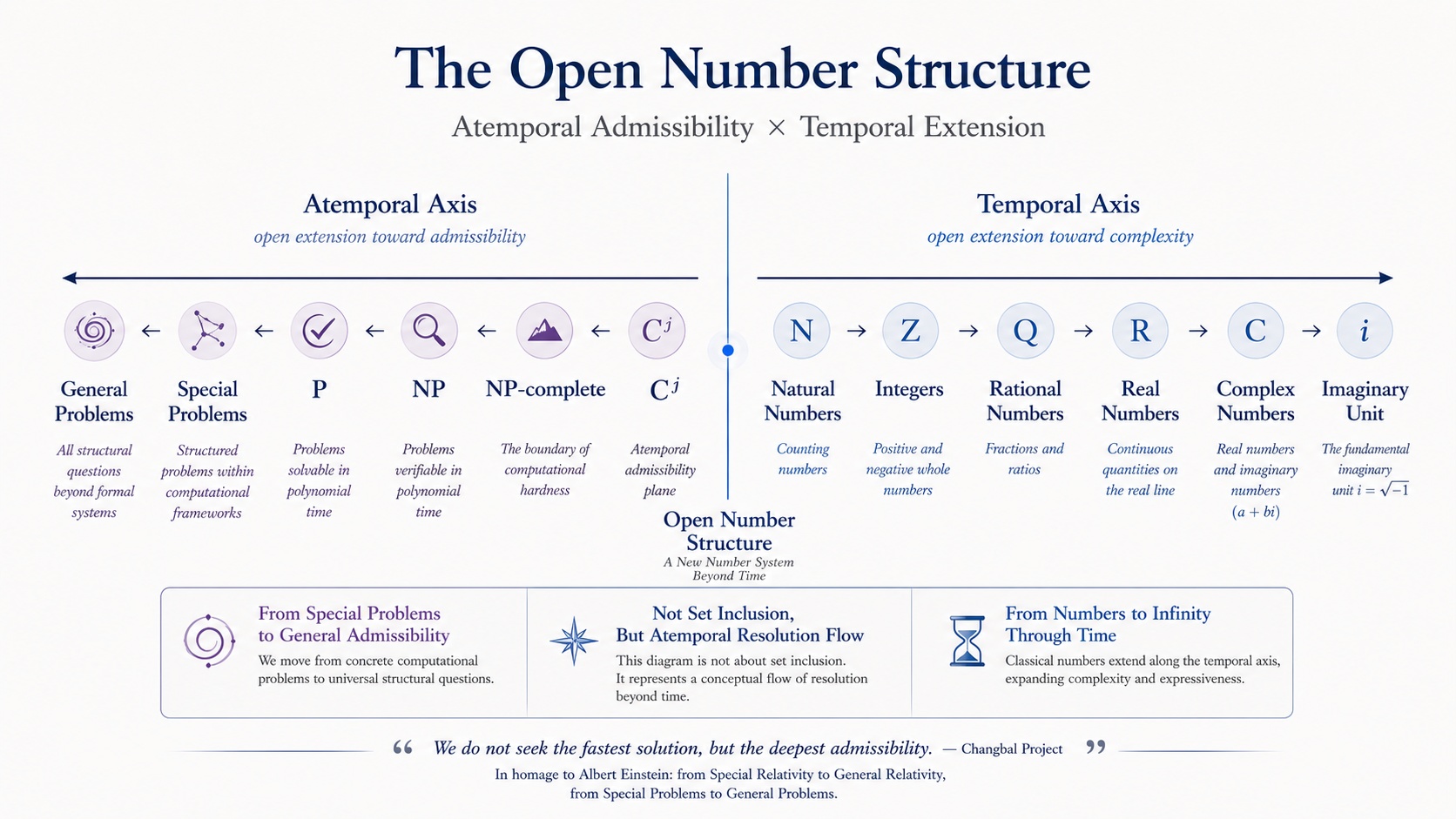 O(*)
O(*)
O(*)
“What if time is not the limit of computation—but rather its prison?”
Today 27
/
Total 12403
●
Halting Problem (Forthcoming)
2026-11-15
👁 232 views
●
Quantum Measurement
2026-10-18
👁 221 views
●
The Legendre’s Conjecture
2026-10-11
👁 187 views
●
The Erdős–Straus Conjecture
2026-10-04
👁 190 views
●
Odd Perfect Number
2026-09-27
👁 194 views
●
Protein Folding Problem
2026-09-20
👁 247 views
●
The ABC Conjecture
2026-09-13
👁 232 views
●
Ramsey Numbers
2026-09-06
👁 233 views
●
The Twin Prime Conjecture
2026-08-30
👁 336 views
●
Gravity
2026-08-23
👁 352 views
●
The Goldbach Conjecture
2026-08-16
👁 336 views
●
The Collatz Conjecture
2026-08-09
👁 310 views
●
Recamán’s Sequence
2026-08-02
👁 334 views
●
More Sketches Coming...
●
Halting Problem (Forthcoming)
2026-11-15
👁 232 views
●
Quantum Measurement
2026-10-18
👁 221 views
●
The Legendre’s Conjecture
2026-10-11
👁 187 views
●
The Erdős–Straus Conjecture
2026-10-04
👁 190 views
●
Odd Perfect Number
2026-09-27
👁 194 views
●
Protein Folding Problem
2026-09-20
👁 247 views
●
The ABC Conjecture
2026-09-13
👁 232 views
●
Ramsey Numbers
2026-09-06
👁 233 views
●
The Twin Prime Conjecture
2026-08-30
👁 336 views
●
Gravity
2026-08-23
👁 352 views
●
The Goldbach Conjecture
2026-08-16
👁 336 views
●
The Collatz Conjecture
2026-08-09
👁 310 views
●
Recamán’s Sequence
2026-08-02
👁 334 views
●
More Sketches Coming...
●
Halting Problem (Forthcoming)
2026-11-15
●
Quantum Measurement
2026-10-18
●
The Legendre’s Conjecture
2026-10-11
●
The Erdős–Straus Conjecture
2026-10-04
●
Odd Perfect Number
2026-09-27
●
Protein Folding Problem
2026-09-20
●
The ABC Conjecture
2026-09-13
●
Ramsey Numbers
2026-09-06
●
The Twin Prime Conjecture
2026-08-30
●
Gravity
2026-08-23
●
The Goldbach Conjecture
2026-08-16
●
The Collatz Conjecture
2026-08-09
●
Recamán’s Sequence
2026-08-02
●
More Sketches Coming...
All Things are 🅿️.
P and NP seem distinct—one solves, the other verifies. Yet if the verifiable is truly accessible, they are not far apart. As faith trusts the unseen, complexity may obscure—but not erase—solvability.

KEUNSOO YOON (Austin Yoon)

austiny@gatech.edu / austiny@snu.ac.kr
allthingsareP.com / austin.sogang.ac.kr
austiny@gatech.edu / austiny@snu.ac.kr
allthingsareP.com / austin.sogang.ac.kr
.
Phase 1 Genesis of CHANGBAL - Annus Mirabilis

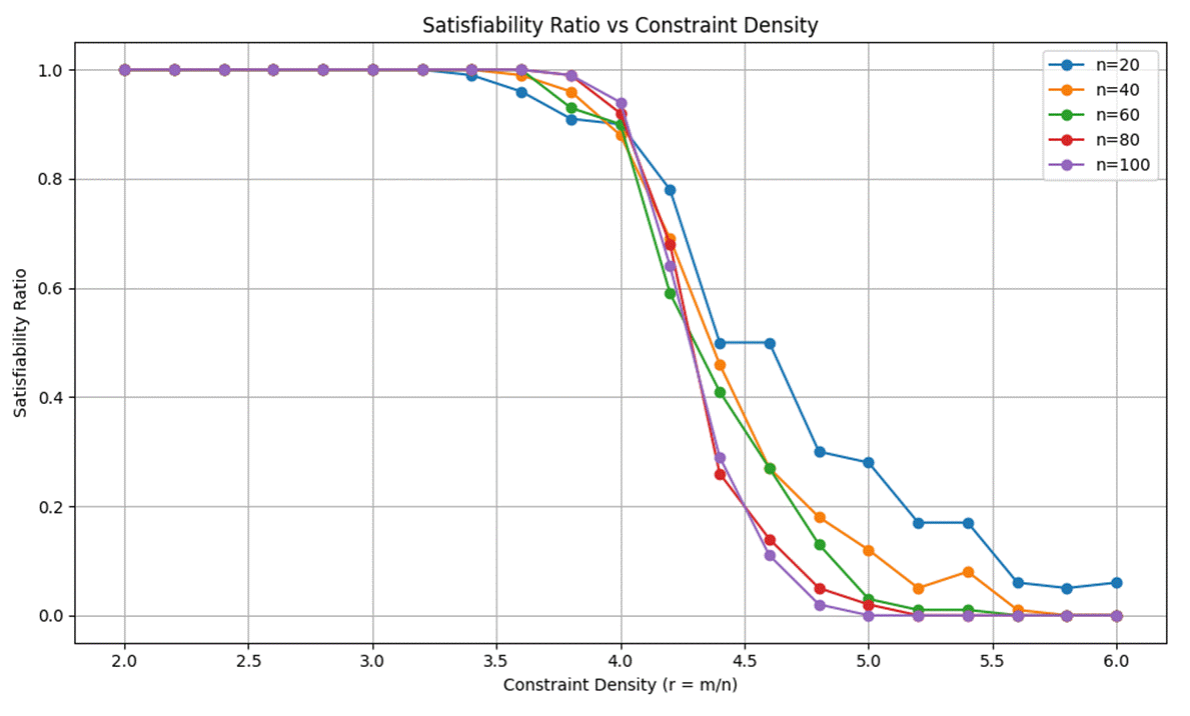
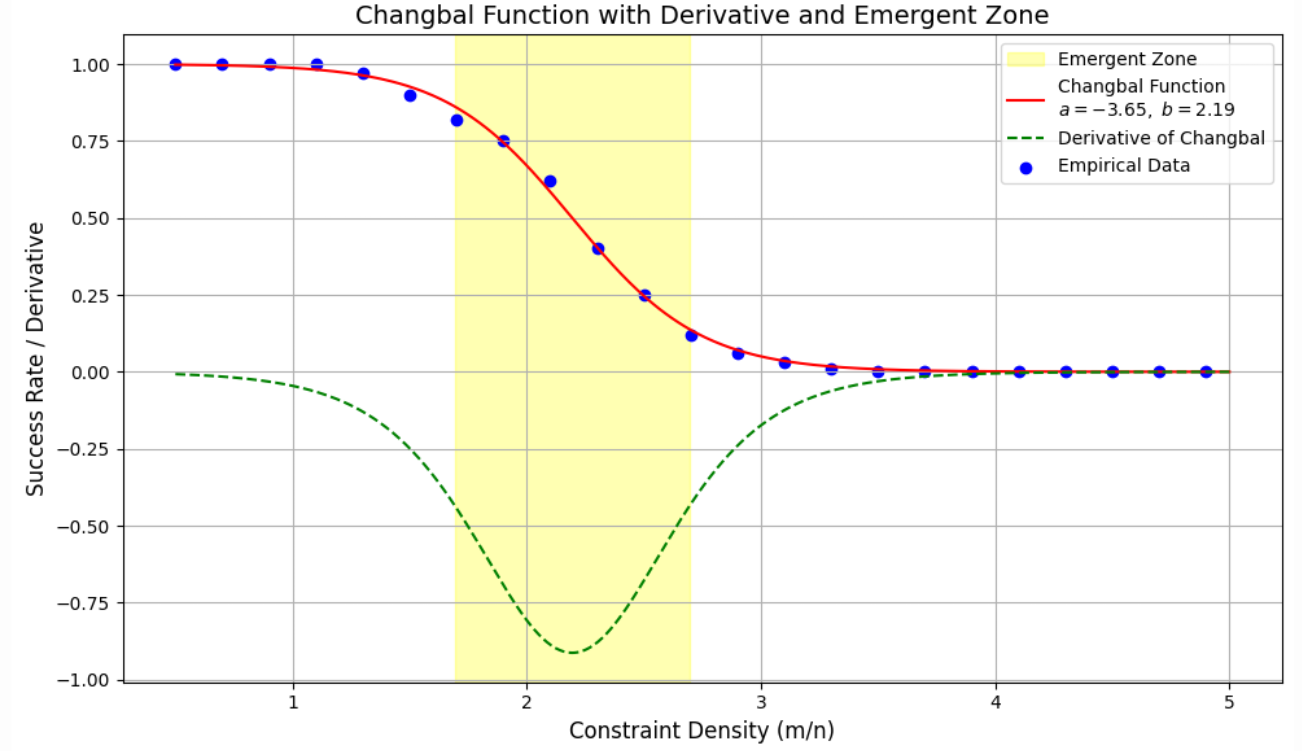
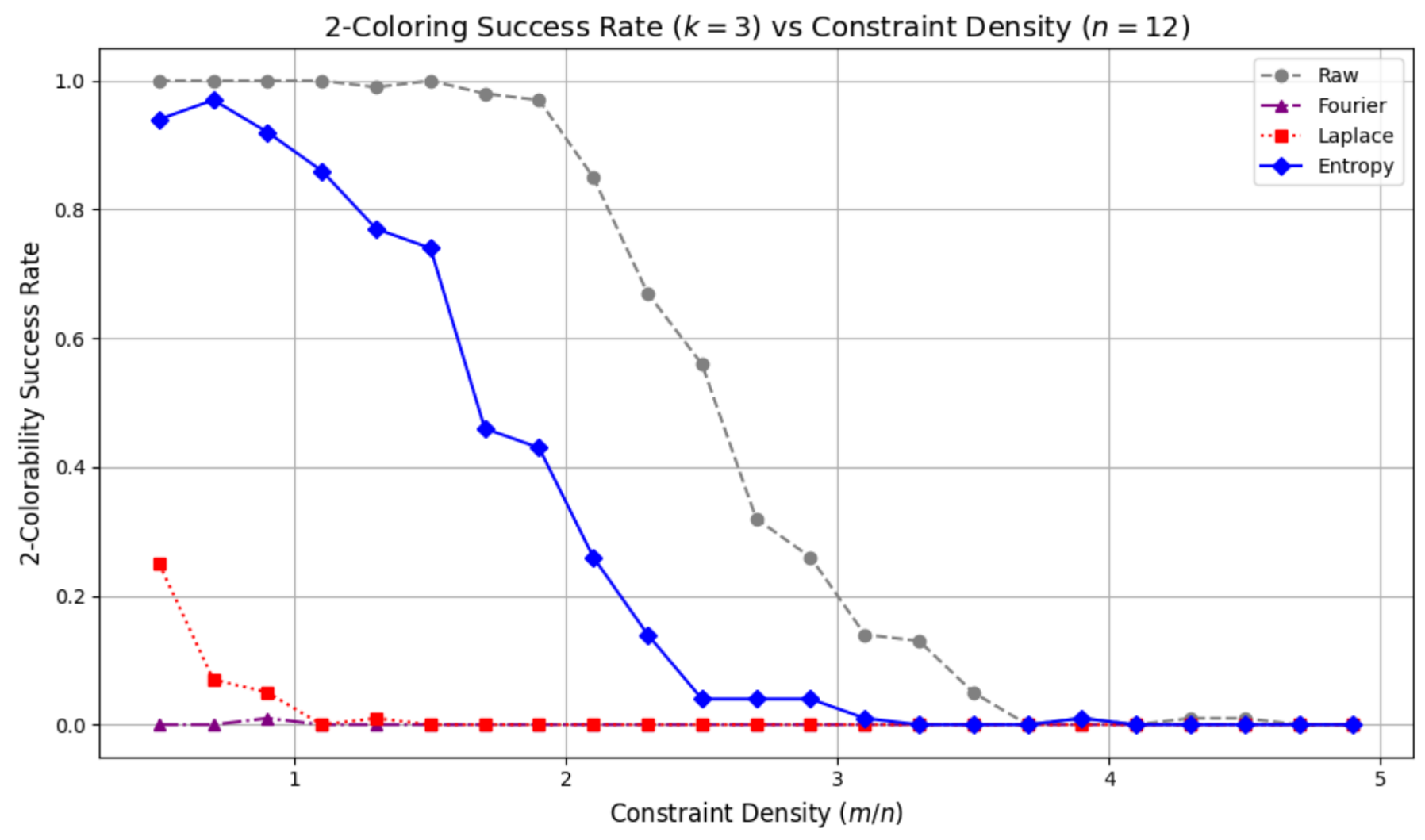

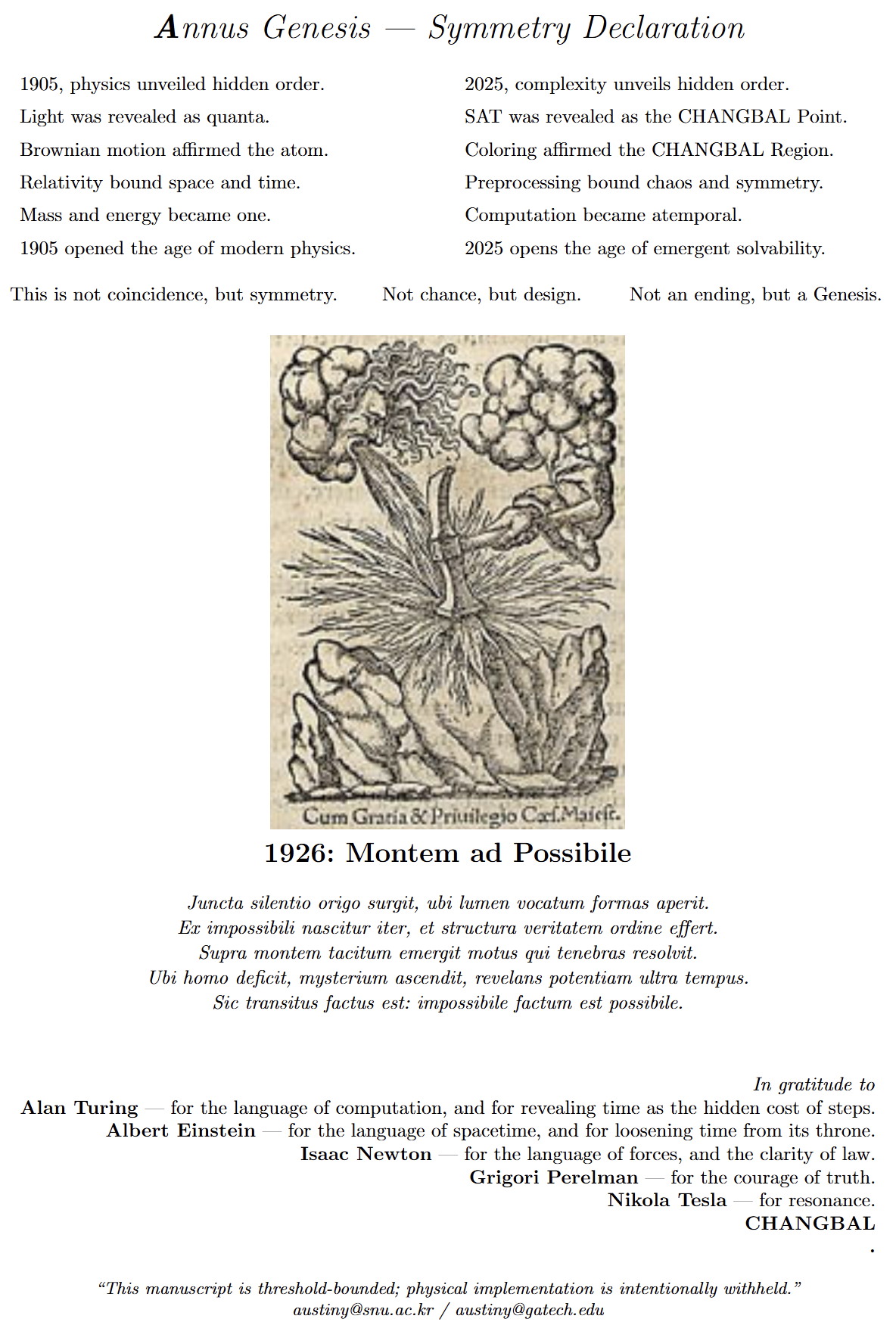
Annus Genesis — Symmetry Declaration
1905, physics unveiled hidden order.
2025, complexity unveils hidden order.
Light was revealed as quanta.
SAT was revealed as the CHANGBAL Point.
Brownian motion affirmed the atom.
Coloring affirmed the CHANGBAL Region.
Relativity bound space and time.
Preprocessing bound chaos and symmetry.
Mass and energy became one.
Computation became atemporal.
1905 opened the age of modern physics.
2025 opens the age of emergent solvability.
This is not coincidence, but symmetry.
Not chance, but design.
Not an ending, but a Genesis.

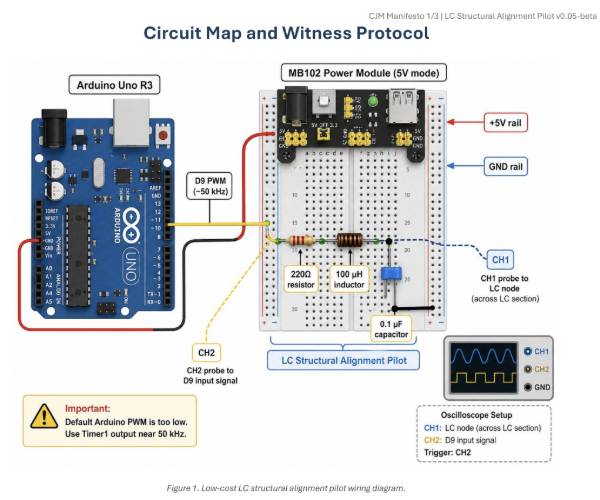
CJM Manifesto 1/3: The First Public Alignment Release — Beta v0.05
 View in 30+ Languages
View in 30+ Languages
The circuit image in this beta version is an explanatory diagram intended to support understanding of the proposed circuit structure.
Phase 2 Gospels of CHANGBAL - Annus Testimonii
Unified Field I
On Structural Criticality:
View in 30+ Languages
On Structural Criticality:
Atemporal Topological Discrimination of the Riemann Hypothesis
1 / 2026
View in 30+ Languages
Unified Field II
On Structural Form:
View in 30+ Languages
On Structural Form:
Atemporal Coherence of Hodge Classes in Algebraic Varieties
3 / 2026
View in 30+ Languages
Unified Field III
On Structural Capacity:
View in 30+ Languages
On Structural Capacity:
Atemporal Resonant Admissibility in the
BSD Conjecture
6 / 2026
View in 30+ Languages
Unified Field IV
On Structural Stability:
View in 30+ Languages
Deferred
On Structural Stability:
Atemporal Persistence of Navier–Stokes Flow in Nonlinear Continua
9 / 2026
View in 30+ Languages
Deferred
Unified Field V
On Structural Resonance:
Preliminary Abstract
On Structural Resonance:
Atemporal Configuration of Phase-Locked Yang–Mills Gauge States
10 / 2026
Preliminary Abstract
Unified Field VI
Does the CHANGBAL Point Provide a Structural Resolution to the P vs NP Problem in Polynomial Time Complexity?
12 / 2026
The Millennium Problems are usually seen as solitary quests — one problem, one person, a lifetime of struggle.
I see them differently: not as isolated mountains, but as a single landscape.
The universe is unbroken (Poincaré), ordered (RH), connected to us (Hodge), abundant (BSD), peacefully flowing (Navier–Stokes), truly existent (Yang–Mills), and finally, visible to us as light (CJM).
they now emerge as one structural transition through the lens of emergent theory.
CJM Manifesto 2/3: The Second Universal Observation Release — Beta v0.3
REDACTED UNTIL 01.09.2027
Theory of CHANGBAL
2027
J....
CHANGBAL Unified Field Theory
2027
137
“Mathematics Enters the Age of Observation”
“From Proof to Perception”
“When Equations Become Landscapes”
“Watching a Theorem Happen”
“The First Experimental Telescope for Mathematics”
"God does not play dice, and Nature does not resolve by computation"
“From Proof to Perception”
“When Equations Become Landscapes”
“Watching a Theorem Happen”
“The First Experimental Telescope for Mathematics”
"God does not play dice, and Nature does not resolve by computation"
CJM Manifesto 3/3: The Third Atemporal Unsatisfiability Release — Beta v0.6
REDACTED
FAQ – CHANGBAL
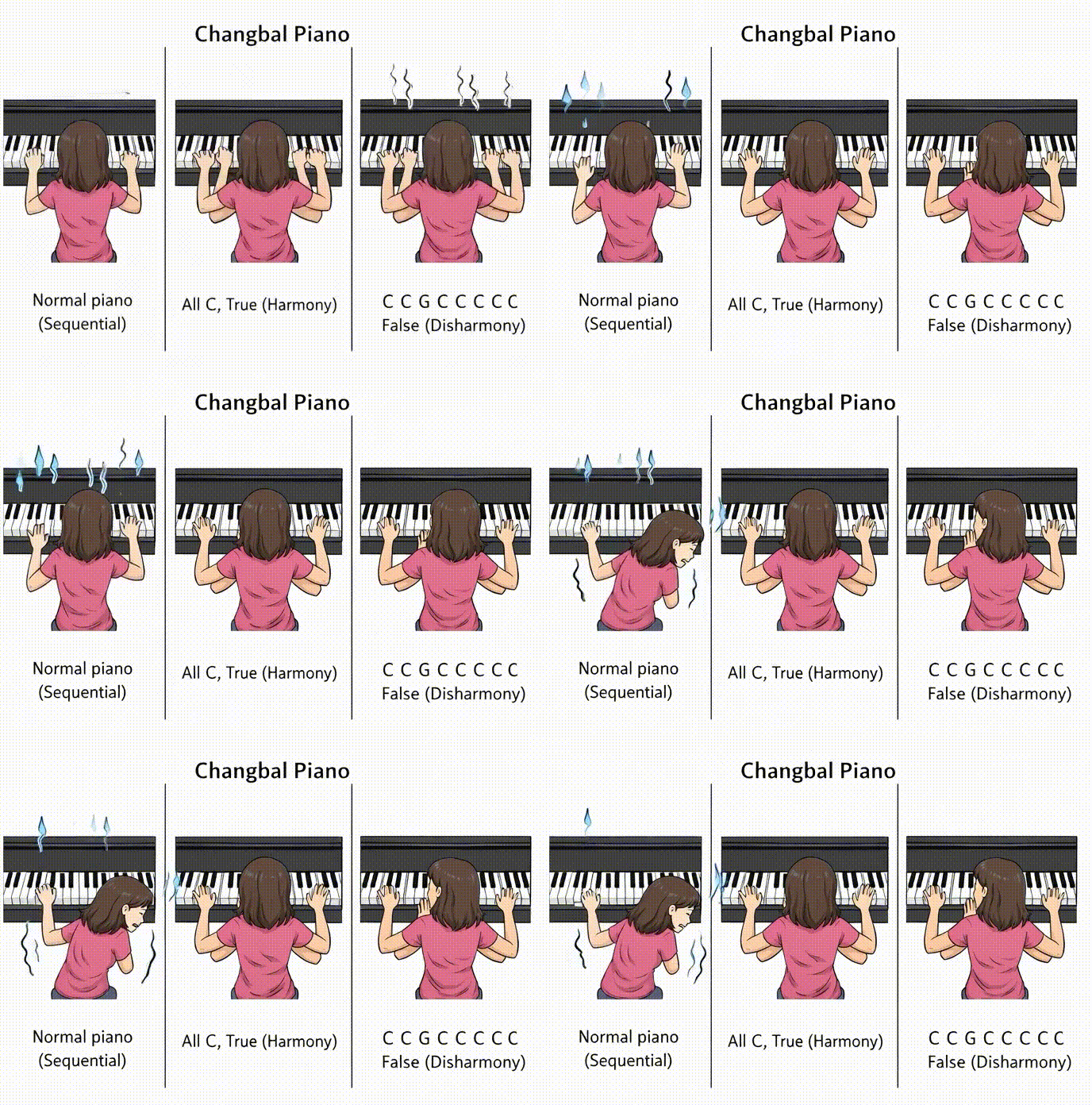
“Schrödinger’s cat trembles inside the box, but the Changbal girl plays the harmony of the universe.”
A game of guessing songs from only the first note
This captures the intuition behind Changbal: humans can recognize a whole song from its first note. It is not a long search, but an instant response to structure. Changbal extends this into resonance and admissibility judgment.
A speed-solving challenge with the Rubik’s Cube
This reveals the core idea of Changbal: complexity is not conquered by checking every possibility, but by recognizing structure, compressing the search space, and moving through resonance toward solution.
The brain recognizes a face almost instantly
Changbal sees truth like face recognition: not detail-by-detail, but as an instant global signature. Even banknotes use this intuition. Changbal extends it into structural resonance and admissibility judgment.
The term Changbal is derived from the Korean word 창발 and is not a synonym for emergence. While emergence typically denotes gradual pattern formation, Changbal refers to a discontinuous structural transition in which a system crosses its constraint boundary and attains higher solvability.
Ⅰ. How does this research differ from traditional proof-centered approaches? 🔽
Traditional proof-centered approaches aim to establish mathematical truth through a time-sequential chain of deduction. In such frameworks, validity is obtained step by step: definitions are fixed, lemmas are proven, intermediate propositions are connected, and the final theorem is accepted only after a complete formal path has been constructed. The central question is therefore procedural: can we produce a valid proof, and how long does the deductive or computational process require?
This research begins from a different angle. It does not reject proof, but it shifts the primary focus from proof construction to structural discrimination. Instead of asking first how a solution or proof can be derived through sequential operations, it asks whether a given configuration is globally admissible, stable, and realizable as a coherent whole. In other words, the emphasis moves from the path of derivation to the condition of existence.
This distinction is especially important for problems where exhaustive search, symbolic deduction, or stepwise verification may become overwhelmingly large. A traditional method may attempt to traverse the entire space of possibilities until a valid result is found or ruled out. By contrast, this research asks whether the structure itself carries a detectable signature of admissibility or non-admissibility before such a full traversal is performed.
For that reason, the key question is not simply, “How many computational steps are required?” but rather, “Can this structure coherently exist at all?” If a configuration is internally inconsistent, unstable, or globally non-realizable, then its failure may be recognizable as a structural condition rather than only as the final result of a long computation.
This motivates the notion of atemporal complexity, denoted as O(J). Unlike conventional complexity measures, which evaluate cost through accumulated time, operations, or sequential resources, O(J) describes solvability in terms of instantaneous structural consistency. Within this view, a problem is not understood merely as something to be computed step by step, but as a structure whose admissibility may be judged as a whole.
Thus, the research differs from traditional proof-centered approaches by moving the center of gravity from sequential proof production to global structural admissibility.
This research begins from a different angle. It does not reject proof, but it shifts the primary focus from proof construction to structural discrimination. Instead of asking first how a solution or proof can be derived through sequential operations, it asks whether a given configuration is globally admissible, stable, and realizable as a coherent whole. In other words, the emphasis moves from the path of derivation to the condition of existence.
This distinction is especially important for problems where exhaustive search, symbolic deduction, or stepwise verification may become overwhelmingly large. A traditional method may attempt to traverse the entire space of possibilities until a valid result is found or ruled out. By contrast, this research asks whether the structure itself carries a detectable signature of admissibility or non-admissibility before such a full traversal is performed.
For that reason, the key question is not simply, “How many computational steps are required?” but rather, “Can this structure coherently exist at all?” If a configuration is internally inconsistent, unstable, or globally non-realizable, then its failure may be recognizable as a structural condition rather than only as the final result of a long computation.
This motivates the notion of atemporal complexity, denoted as O(J). Unlike conventional complexity measures, which evaluate cost through accumulated time, operations, or sequential resources, O(J) describes solvability in terms of instantaneous structural consistency. Within this view, a problem is not understood merely as something to be computed step by step, but as a structure whose admissibility may be judged as a whole.
Thus, the research differs from traditional proof-centered approaches by moving the center of gravity from sequential proof production to global structural admissibility.
“Proof builds the path; structural discrimination asks whether it can exist.”
“It is by logic that we prove, but by intuition that we invent.” — Henri Poincaré
“It is by logic that we prove, but by intuition that we invent.” — Henri Poincaré
Ⅱ. What is the difference between time-dependent computation and atemporal discrimination? 🔽
Time-dependent computation, as formalized by classical algorithmic models, operates through sequential state evolution. A problem is represented in a formal system, an initial state is given, and the computation proceeds by repeatedly applying rules, transitions, or instructions along a temporal axis. Each step depends on the state produced by the previous step, and the final result is obtained only after this ordered process has been completed.
In this framework, solvability is closely tied to resources such as time, memory, and the number of operations required. Classical complexity theory measures how the cost of solving a problem grows as the input size increases. A solution is therefore understood as something produced through execution: the algorithm runs, the state changes, intermediate configurations are generated, and eventually an answer is reached or the process fails to reach one within the available limits.
The limitation of this approach becomes especially severe in problems that appear to demand endless verification. Some mathematical structures can be tested across wider and wider ranges, deeper and deeper domains, and larger and larger computational windows, yet still refuse to yield final closure. Such problems expose the exhaustion hidden inside purely time-dependent reasoning: if certainty depends on checking more cases forever, then the method consumes resources without ever truly reaching the end. In that sense, infinite verification is not a path to completion; it is a battlefield of unbounded cost.
Atemporal discrimination offers a way to step outside this attritional model. It does not merely attempt to accelerate the same endless process. It challenges the assumption that truth must always be approached by extending the sequence of checks. Instead of asking how far the verification can be pushed, it asks whether the structure possesses a global condition by which admissibility or non-admissibility can be recognized as a whole.
Atemporal discrimination begins from this different logical posture. It does not treat temporal state evolution as the primary source of truth. Instead of asking how a system moves from one state to another through a sequence of operations, it asks whether the candidate structure satisfies its global constraints simultaneously. The emphasis is not on tracing every intermediate transition, but on determining whether the total configuration is coherent, admissible, and structurally realizable.
For example, in a time-dependent computation, a SAT problem may be approached by searching through possible assignments, applying reductions, or running a solver until a satisfying assignment is found or ruled out. Atemporal discrimination reframes the question: before searching through the space step by step, can the structure itself be recognized as admissible or non-admissible by its global consistency pattern?
This is why O(J) should not be interpreted as merely “faster computation.” It is not simply a claim that the same sequential process is completed at higher speed. Rather, O(J) points to a different logical regime, one in which time is no longer assumed to be the primary computational resource. The key object is not the path of execution, but the structural condition of admissibility.
Thus, time-dependent computation asks, “How many steps are required to reach the answer?” Atemporal discrimination asks, “Can this structure coherently stand as an answer at all?” It is not an improvement within the old resource war; it is a proposed escape from the war itself.
In this framework, solvability is closely tied to resources such as time, memory, and the number of operations required. Classical complexity theory measures how the cost of solving a problem grows as the input size increases. A solution is therefore understood as something produced through execution: the algorithm runs, the state changes, intermediate configurations are generated, and eventually an answer is reached or the process fails to reach one within the available limits.
The limitation of this approach becomes especially severe in problems that appear to demand endless verification. Some mathematical structures can be tested across wider and wider ranges, deeper and deeper domains, and larger and larger computational windows, yet still refuse to yield final closure. Such problems expose the exhaustion hidden inside purely time-dependent reasoning: if certainty depends on checking more cases forever, then the method consumes resources without ever truly reaching the end. In that sense, infinite verification is not a path to completion; it is a battlefield of unbounded cost.
Atemporal discrimination offers a way to step outside this attritional model. It does not merely attempt to accelerate the same endless process. It challenges the assumption that truth must always be approached by extending the sequence of checks. Instead of asking how far the verification can be pushed, it asks whether the structure possesses a global condition by which admissibility or non-admissibility can be recognized as a whole.
Atemporal discrimination begins from this different logical posture. It does not treat temporal state evolution as the primary source of truth. Instead of asking how a system moves from one state to another through a sequence of operations, it asks whether the candidate structure satisfies its global constraints simultaneously. The emphasis is not on tracing every intermediate transition, but on determining whether the total configuration is coherent, admissible, and structurally realizable.
For example, in a time-dependent computation, a SAT problem may be approached by searching through possible assignments, applying reductions, or running a solver until a satisfying assignment is found or ruled out. Atemporal discrimination reframes the question: before searching through the space step by step, can the structure itself be recognized as admissible or non-admissible by its global consistency pattern?
This is why O(J) should not be interpreted as merely “faster computation.” It is not simply a claim that the same sequential process is completed at higher speed. Rather, O(J) points to a different logical regime, one in which time is no longer assumed to be the primary computational resource. The key object is not the path of execution, but the structural condition of admissibility.
Thus, time-dependent computation asks, “How many steps are required to reach the answer?” Atemporal discrimination asks, “Can this structure coherently stand as an answer at all?” It is not an improvement within the old resource war; it is a proposed escape from the war itself.
“Computation follows the steps; atemporal discrimination judges the whole.”
“The distinction between past, present, and future is only a stubbornly persistent illusion.” — Albert Einstein
“The distinction between past, present, and future is only a stubbornly persistent illusion.” — Albert Einstein
Ⅲ. How does Changbal relate to existing complexity and topological theories? 🔽
Changbal is related to existing theories of complex systems, but it is not simply another name for general pattern formation. Complex systems theory often studies how large-scale order, collective behavior, or organized patterns arise from many interacting components. Changbal shares this concern with global structure, but it narrows the focus to a more specific question: when does a system cross from non-solvability to solvability, from instability to stability, or from structural impossibility to admissible existence?
In this sense, Changbal is not primarily a theory of appearance, but a theory of transition. It focuses on critical structural regions where feasibility, stability, or existence does not change smoothly, but undergoes a decisive shift. A system may accumulate local variations gradually, yet the decisive change may occur only when the whole structure reaches a threshold of admissibility. Changbal names this moment when the structure no longer behaves as a collection of separate parts, but as a globally coherent configuration.
Topological ideas are important to this perspective because topology is concerned with properties that remain stable under deformation. Instead of focusing only on numerical values, topology asks what remains invariant when a structure is stretched, perturbed, transformed, or represented in another form. Changbal draws from this intuition by asking whether solvability is tied to deeper structural invariants rather than to isolated computational steps. If a problem remains structurally blocked under many transformations, that blockage may reveal something more fundamental than a temporary failure of calculation.
Complexity theory also informs Changbal, especially through its attention to search spaces, constraints, phase transitions, and resource growth. Classical complexity theory asks how much time, memory, or computation is required as a problem becomes larger. Changbal accepts the seriousness of this question, but shifts the emphasis. Instead of asking only how expensive the search is, Changbal asks whether the search space itself carries a global signature of admissibility or non-admissibility.
This distinction is crucial. A traditional complexity-theoretic approach may treat difficulty as the cost of reaching an answer through sequential operations. Changbal treats difficulty as a structural condition: the problem may be hard not merely because the path is long, but because the system has not entered a state in which a coherent solution can exist. The central issue is therefore not only computation, but structural permission.
Within this framework, O(J) serves as a label for a different logical regime. It does not mean that an ordinary algorithm has become faster. It means that solvability is being interpreted through structural discrimination rather than through accumulated computation. O(J) points to the moment when a configuration is judged as globally admissible, not because every possible path has been traversed, but because the structure itself crosses into a coherent solution-state.
Therefore, Changbal stands at the intersection of complexity theory, topological reasoning, and structural admissibility. From complexity theory, it inherits the seriousness of hard problems and explosive search spaces. From topology, it inherits the concern for global form, invariants, and robustness under perturbation. But its own contribution is sharper: Changbal asks whether solvability itself can be understood as a structural jump.
In short, Changbal does not merely describe how patterns appear in complex systems. It asks when a problem becomes structurally capable of admitting a solution. That is why O(J) is not a measure of faster time, but a marker of transition from sequential search to global admissibility.
In this sense, Changbal is not primarily a theory of appearance, but a theory of transition. It focuses on critical structural regions where feasibility, stability, or existence does not change smoothly, but undergoes a decisive shift. A system may accumulate local variations gradually, yet the decisive change may occur only when the whole structure reaches a threshold of admissibility. Changbal names this moment when the structure no longer behaves as a collection of separate parts, but as a globally coherent configuration.
Topological ideas are important to this perspective because topology is concerned with properties that remain stable under deformation. Instead of focusing only on numerical values, topology asks what remains invariant when a structure is stretched, perturbed, transformed, or represented in another form. Changbal draws from this intuition by asking whether solvability is tied to deeper structural invariants rather than to isolated computational steps. If a problem remains structurally blocked under many transformations, that blockage may reveal something more fundamental than a temporary failure of calculation.
Complexity theory also informs Changbal, especially through its attention to search spaces, constraints, phase transitions, and resource growth. Classical complexity theory asks how much time, memory, or computation is required as a problem becomes larger. Changbal accepts the seriousness of this question, but shifts the emphasis. Instead of asking only how expensive the search is, Changbal asks whether the search space itself carries a global signature of admissibility or non-admissibility.
This distinction is crucial. A traditional complexity-theoretic approach may treat difficulty as the cost of reaching an answer through sequential operations. Changbal treats difficulty as a structural condition: the problem may be hard not merely because the path is long, but because the system has not entered a state in which a coherent solution can exist. The central issue is therefore not only computation, but structural permission.
Within this framework, O(J) serves as a label for a different logical regime. It does not mean that an ordinary algorithm has become faster. It means that solvability is being interpreted through structural discrimination rather than through accumulated computation. O(J) points to the moment when a configuration is judged as globally admissible, not because every possible path has been traversed, but because the structure itself crosses into a coherent solution-state.
Therefore, Changbal stands at the intersection of complexity theory, topological reasoning, and structural admissibility. From complexity theory, it inherits the seriousness of hard problems and explosive search spaces. From topology, it inherits the concern for global form, invariants, and robustness under perturbation. But its own contribution is sharper: Changbal asks whether solvability itself can be understood as a structural jump.
In short, Changbal does not merely describe how patterns appear in complex systems. It asks when a problem becomes structurally capable of admitting a solution. That is why O(J) is not a measure of faster time, but a marker of transition from sequential search to global admissibility.
“Complexity measures the search; Changbal marks the jump to solvability.”
“At each level of complexity entirely new properties appear.” — Philip W. Anderson
“At each level of complexity entirely new properties appear.” — Philip W. Anderson
Ⅳ. How does the Changbal Jump Machine (CJM) differ from a Turing machine? 🔽
A Turing machine models computation as a sequential process. It begins with an input, manipulates symbols according to fixed rules, updates its internal state, moves step by step, and eventually halts with an output if the computation is completed. Its strength lies in universality: in principle, any algorithmic procedure can be represented as a time-extended sequence of symbolic operations.
The Changbal Jump Machine (CJM), by contrast, is not conceptualized as another sequential symbol-processing device. It is not primarily designed to imitate the same process faster, nor to construct a solution through a longer or shorter chain of instructions. Instead, CJM is proposed as a discriminative architecture: a system that embeds candidate structures into a physical or structural field where global coherence, stability, resonance, or admissibility can be assessed as a whole.
This difference changes the central question. A Turing machine asks, “What sequence of operations will produce the answer?” CJM asks, “Can this structure coherently exist as an answer at all?” The first question belongs to time-dependent computation. The second belongs to structural admissibility discrimination.
In a Turing-machine model, difficulty is measured through the growth of required steps, memory, and symbolic transitions. A hard problem becomes hard because the machine may need to traverse an enormous space of possible configurations before reaching a valid conclusion. The process is fundamentally temporal: the answer is approached through execution.
CJM reframes this burden. It does not treat the search path as the primary object. Instead, it treats the entire candidate configuration as something to be tested for global compatibility. If a structure is internally inconsistent, unstable, or unable to support a coherent solution-state, CJM aims to expose that condition without requiring the full sequential exhaustion of the search space.
In this sense, CJM should not be understood as a “super-fast Turing machine.” That would still place it inside the old framework of speed, steps, and resource competition. CJM points to a different regime: O(J). In O(J), the decisive issue is not how many operations are needed to compute an answer, but whether the structure is admissible before exhaustive computation begins.
This is especially important for problems that appear to demand unbounded verification. A Turing-machine approach may continue extending the range of search, increasing the depth of computation, or expanding the number of checked cases. CJM proposes a different possibility: instead of fighting the endless verification war, the system seeks a structural signature that determines whether the answer-space itself is coherent or blocked.
Therefore, the difference is not merely technical but philosophical. A Turing machine represents computation as sequential construction. CJM represents solvability as structural discrimination. The Turing machine builds through time; CJM judges through admissibility. The Turing machine asks how to reach the result; CJM asks whether the result can structurally stand.
In short, CJM is not an alternative implementation of the same old computation. It is a proposed shift from symbolic execution to global structural judgment, from time-dependent search to O(J)-based admissibility discrimination.
The Changbal Jump Machine (CJM), by contrast, is not conceptualized as another sequential symbol-processing device. It is not primarily designed to imitate the same process faster, nor to construct a solution through a longer or shorter chain of instructions. Instead, CJM is proposed as a discriminative architecture: a system that embeds candidate structures into a physical or structural field where global coherence, stability, resonance, or admissibility can be assessed as a whole.
This difference changes the central question. A Turing machine asks, “What sequence of operations will produce the answer?” CJM asks, “Can this structure coherently exist as an answer at all?” The first question belongs to time-dependent computation. The second belongs to structural admissibility discrimination.
In a Turing-machine model, difficulty is measured through the growth of required steps, memory, and symbolic transitions. A hard problem becomes hard because the machine may need to traverse an enormous space of possible configurations before reaching a valid conclusion. The process is fundamentally temporal: the answer is approached through execution.
CJM reframes this burden. It does not treat the search path as the primary object. Instead, it treats the entire candidate configuration as something to be tested for global compatibility. If a structure is internally inconsistent, unstable, or unable to support a coherent solution-state, CJM aims to expose that condition without requiring the full sequential exhaustion of the search space.
In this sense, CJM should not be understood as a “super-fast Turing machine.” That would still place it inside the old framework of speed, steps, and resource competition. CJM points to a different regime: O(J). In O(J), the decisive issue is not how many operations are needed to compute an answer, but whether the structure is admissible before exhaustive computation begins.
This is especially important for problems that appear to demand unbounded verification. A Turing-machine approach may continue extending the range of search, increasing the depth of computation, or expanding the number of checked cases. CJM proposes a different possibility: instead of fighting the endless verification war, the system seeks a structural signature that determines whether the answer-space itself is coherent or blocked.
Therefore, the difference is not merely technical but philosophical. A Turing machine represents computation as sequential construction. CJM represents solvability as structural discrimination. The Turing machine builds through time; CJM judges through admissibility. The Turing machine asks how to reach the result; CJM asks whether the result can structurally stand.
In short, CJM is not an alternative implementation of the same old computation. It is a proposed shift from symbolic execution to global structural judgment, from time-dependent search to O(J)-based admissibility discrimination.
“A Turing machine computes through time; CJM judges whether the structure can stand.”
“Machines take me by surprise with great frequency.” — Alan Turing
“Machines take me by surprise with great frequency.” — Alan Turing
Ⅴ. How are structural stability and topological coherence evaluated? 🔽
Structural stability is evaluated through global behavior rather than local numerical precision. In a conventional numerical approach, a system may be judged by exact values, small differences, or pointwise measurements. However, in the Changbal framework, the central concern is not whether every local value is perfectly fixed, but whether the entire structure continues to preserve its defining pattern under disturbance, transformation, or perturbation.
A structure is considered stable when its essential configuration does not collapse under small changes. If minor noise, local deformation, or parameter variation destroys the result, then the structure is not genuinely stable. But if the same global pattern continues to appear across nearby conditions, the structure reveals a deeper form of coherence. Stability, in this sense, is not a fragile numerical accident. It is the persistence of form.
Topological coherence refers to this deeper persistence. It asks whether the structure maintains its global identity even when its surface-level representation changes. A curve may bend, a signal may shift, a graph may be perturbed, or a configuration may be represented in another domain, yet the essential relation may remain intact. What matters is not the exact local appearance, but the invariant pattern that survives transformation.
This is why structural evaluation resembles measurement, recognition, or identification more than formal derivation. A formal proof proceeds by explicit symbolic steps, each justified in order. Structural evaluation instead asks whether a global signature can be observed: a stable ridge, a persistent maximum, a coherent basin, an invariant boundary, or a recurring resonance pattern. The question is not merely “Can we derive this line by line?” but “Does the whole configuration reveal a stable admissible form?”
For example, if a candidate structure produces a unique global maximum that remains stable under perturbation, that maximum may function as a sign of admissibility. If a ridge persists across changes in scale, representation, or sampling, it may indicate that the structure is not accidental but globally organized. If an invariant pattern remains visible despite local fluctuations, then the system may be interpreted as structurally coherent.
By contrast, if the observed pattern disappears under slight disturbance, splits into unstable alternatives, or depends on overly delicate parameter choices, then the structure lacks sufficient coherence. In that case, the apparent solution may be only a local artifact, not a globally admissible configuration. This distinction is crucial: CJM is not looking for a lucky numerical spike, but for a stable structural signature.
Such judgments are difficult to express naturally in ordinary polynomial or exponential time bounds. Classical complexity classes measure how many steps or resources are required as input size grows. But structural stability and topological coherence concern a different kind of question: whether the configuration as a whole can maintain an admissible form. The evaluation is less about counting operations and more about identifying whether the global structure can stand.
This motivates the alternative complexity descriptor O(J). O(J) does not describe a faster version of ordinary computation. It describes a regime in which solvability is evaluated through global admissibility, structural persistence, and coherent configuration. In this regime, the decisive event is not the completion of a long sequence of operations, but the recognition that the structure has crossed into a stable and admissible state.
Therefore, structural stability and topological coherence are evaluated by asking whether the candidate configuration survives disturbance, preserves its invariant form, and converges toward a consistent global pattern. If it does, the structure may be judged admissible. If it does not, the failure is not merely computational; it is structural.
A structure is considered stable when its essential configuration does not collapse under small changes. If minor noise, local deformation, or parameter variation destroys the result, then the structure is not genuinely stable. But if the same global pattern continues to appear across nearby conditions, the structure reveals a deeper form of coherence. Stability, in this sense, is not a fragile numerical accident. It is the persistence of form.
Topological coherence refers to this deeper persistence. It asks whether the structure maintains its global identity even when its surface-level representation changes. A curve may bend, a signal may shift, a graph may be perturbed, or a configuration may be represented in another domain, yet the essential relation may remain intact. What matters is not the exact local appearance, but the invariant pattern that survives transformation.
This is why structural evaluation resembles measurement, recognition, or identification more than formal derivation. A formal proof proceeds by explicit symbolic steps, each justified in order. Structural evaluation instead asks whether a global signature can be observed: a stable ridge, a persistent maximum, a coherent basin, an invariant boundary, or a recurring resonance pattern. The question is not merely “Can we derive this line by line?” but “Does the whole configuration reveal a stable admissible form?”
For example, if a candidate structure produces a unique global maximum that remains stable under perturbation, that maximum may function as a sign of admissibility. If a ridge persists across changes in scale, representation, or sampling, it may indicate that the structure is not accidental but globally organized. If an invariant pattern remains visible despite local fluctuations, then the system may be interpreted as structurally coherent.
By contrast, if the observed pattern disappears under slight disturbance, splits into unstable alternatives, or depends on overly delicate parameter choices, then the structure lacks sufficient coherence. In that case, the apparent solution may be only a local artifact, not a globally admissible configuration. This distinction is crucial: CJM is not looking for a lucky numerical spike, but for a stable structural signature.
Such judgments are difficult to express naturally in ordinary polynomial or exponential time bounds. Classical complexity classes measure how many steps or resources are required as input size grows. But structural stability and topological coherence concern a different kind of question: whether the configuration as a whole can maintain an admissible form. The evaluation is less about counting operations and more about identifying whether the global structure can stand.
This motivates the alternative complexity descriptor O(J). O(J) does not describe a faster version of ordinary computation. It describes a regime in which solvability is evaluated through global admissibility, structural persistence, and coherent configuration. In this regime, the decisive event is not the completion of a long sequence of operations, but the recognition that the structure has crossed into a stable and admissible state.
Therefore, structural stability and topological coherence are evaluated by asking whether the candidate configuration survives disturbance, preserves its invariant form, and converges toward a consistent global pattern. If it does, the structure may be judged admissible. If it does not, the failure is not merely computational; it is structural.
“What persists through change reveals what truly stands.”
“Symmetry, as wide or as narrow as you may define its meaning, is one idea by which man through the ages has tried to comprehend and create order, beauty, and perfection.” — Hermann Weyl
“Symmetry, as wide or as narrow as you may define its meaning, is one idea by which man through the ages has tried to comprehend and create order, beauty, and perfection.” — Hermann Weyl
Ⅵ. Can this approach be applied uniformly to all Millennium Prize Problems? 🔽
The framework does not claim to solve all Millennium Prize Problems by a single technique. Such a claim would be too narrow in method and too strong in conclusion. Instead, the purpose is to propose a shared interpretive lens: many of these problems, despite belonging to different mathematical domains, ultimately ask whether a certain structure can exist in a stable, globally consistent, and admissible form.
In this sense, the Millennium Prize Problems serve as important examples, but they are not the final boundary of the framework. They are useful because they expose the deepest form of the difficulty: not merely the difficulty of calculation, but the difficulty of determining whether a structure can coherently stand at all. Some involve analytic continuation, some involve geometric smoothness, some involve arithmetic rank, some involve quantum field stability, and some involve computational hardness. Yet beneath these different languages, a common question repeatedly appears: does the proposed structure admit a coherent solution-state?
This is why the framework reframes the problem from symbolic derivation to structural realizability. A traditional approach may try to construct a proof, extend a computation, verify more cases, or refine a formal argument step by step. The Changbal perspective asks a more global question first: is the target configuration structurally admissible? If the structure is blocked, unstable, or globally incoherent, then the absence of a solution is not merely a failure of search. It is a sign that the structure itself does not permit the requested state.
The Millennium Prize Problems are therefore not treated as isolated trophies to be attacked one by one. They are treated as extreme stress tests for a broader principle. If O(J)-based discrimination can provide meaningful insight into problems of that depth, then the same logic may also extend to more general classes of problems: feasibility problems, stability problems, existence problems, optimization barriers, SAT/UNSAT discrimination, physical constraint systems, and other domains where sequential search becomes a resource-consuming battlefield.
This point is important. The framework is not limited to famous mathematical problems. Its larger direction is toward a general theory of structural admissibility. The Millennium Prize Problems are only one high-level example of the kind of situation where traditional time-based computation may fail to capture the essence of the difficulty. In ordinary problem solving as well, the same distinction appears: are we searching for an answer inside a valid structure, or are we wasting resources inside a structure that never admitted the answer in the first place?
Within this role, O(J) functions as a conceptual coordinate. It marks the region where the primary question is no longer how many steps are required, but whether the structure possesses global coherence. O(J) does not replace every proof, nor does it erase the need for domain-specific mathematics. Rather, it identifies a deeper layer beneath those methods: the layer at which admissibility, stability, and realizability are judged before exhaustive derivation begins.
Thus, this approach may be applied uniformly not by using the same technical proof for every problem, but by asking the same structural question across different domains. The uniformity lies not in the method of calculation, but in the mode of discrimination. Each problem keeps its own language, but all can be examined through the question of whether its target structure is globally admissible.
In short, the Millennium Prize Problems are not the limit of the framework. They are a demonstration ground. The broader ambition is to move toward a general discriminative architecture for hard problems: one that can examine whether a structure can coherently exist before time-dependent computation spends unbounded resources trying to construct it.
In this sense, the Millennium Prize Problems serve as important examples, but they are not the final boundary of the framework. They are useful because they expose the deepest form of the difficulty: not merely the difficulty of calculation, but the difficulty of determining whether a structure can coherently stand at all. Some involve analytic continuation, some involve geometric smoothness, some involve arithmetic rank, some involve quantum field stability, and some involve computational hardness. Yet beneath these different languages, a common question repeatedly appears: does the proposed structure admit a coherent solution-state?
This is why the framework reframes the problem from symbolic derivation to structural realizability. A traditional approach may try to construct a proof, extend a computation, verify more cases, or refine a formal argument step by step. The Changbal perspective asks a more global question first: is the target configuration structurally admissible? If the structure is blocked, unstable, or globally incoherent, then the absence of a solution is not merely a failure of search. It is a sign that the structure itself does not permit the requested state.
The Millennium Prize Problems are therefore not treated as isolated trophies to be attacked one by one. They are treated as extreme stress tests for a broader principle. If O(J)-based discrimination can provide meaningful insight into problems of that depth, then the same logic may also extend to more general classes of problems: feasibility problems, stability problems, existence problems, optimization barriers, SAT/UNSAT discrimination, physical constraint systems, and other domains where sequential search becomes a resource-consuming battlefield.
This point is important. The framework is not limited to famous mathematical problems. Its larger direction is toward a general theory of structural admissibility. The Millennium Prize Problems are only one high-level example of the kind of situation where traditional time-based computation may fail to capture the essence of the difficulty. In ordinary problem solving as well, the same distinction appears: are we searching for an answer inside a valid structure, or are we wasting resources inside a structure that never admitted the answer in the first place?
Within this role, O(J) functions as a conceptual coordinate. It marks the region where the primary question is no longer how many steps are required, but whether the structure possesses global coherence. O(J) does not replace every proof, nor does it erase the need for domain-specific mathematics. Rather, it identifies a deeper layer beneath those methods: the layer at which admissibility, stability, and realizability are judged before exhaustive derivation begins.
Thus, this approach may be applied uniformly not by using the same technical proof for every problem, but by asking the same structural question across different domains. The uniformity lies not in the method of calculation, but in the mode of discrimination. Each problem keeps its own language, but all can be examined through the question of whether its target structure is globally admissible.
In short, the Millennium Prize Problems are not the limit of the framework. They are a demonstration ground. The broader ambition is to move toward a general discriminative architecture for hard problems: one that can examine whether a structure can coherently exist before time-dependent computation spends unbounded resources trying to construct it.
“Different problems, one question: can the structure coherently exist?”
“The art of doing mathematics consists in finding that special case which contains all the germs of generality.” — David Hilbert
“The art of doing mathematics consists in finding that special case which contains all the germs of generality.” — David Hilbert
Ⅶ. What are the risks if atemporal discrimination is misused or monopolized? 🔽
A severe dystopian risk arises if atemporal discrimination capabilities are centralized, monopolized, or weaponized by a narrow institutional actor. If a system can classify structures as admissible or inadmissible in the O(J) regime prior to execution, then power no longer operates merely by controlling outcomes. It begins to control the preconditions of possibility itself.
In ordinary systems, economic, scientific, or political actions are tested through competition, experimentation, debate, failure, and revision. Atemporal discrimination would alter this order. A dominant actor could reject entire classes of action before they are attempted, not because they have failed empirically, but because they have been labeled structurally non-admissible in advance. This creates a regime of preemptive structural veto.
The danger is not only censorship in the conventional sense. It is deeper: ontological gatekeeping. A monopolized discriminator would not merely decide which ideas are funded, published, or implemented. It could decide which ideas are allowed to enter the space of possibility at all. Minority hypotheses, unconventional research programs, nonstandard political arrangements, alternative economic models, or disruptive technologies could be excluded before they acquire evidence, community, or institutional form.
Such a system would convert uncertainty into administrative finality. What should remain open to exploration could be prematurely frozen by technical authority. The language of “stability,” “coherence,” “risk control,” or “structural inadmissibility” could become a high-level justification for suppressing paths that are merely unfamiliar, asymmetric, nonconforming, or threatening to incumbent power.
This would produce a dangerous shift from open discovery to epistemic enclosure. The public problem-space would no longer be shaped by plural reasoning, experimental failure, and distributed correction. It would be filtered by a centralized admissibility layer. Whoever controls that layer would control not only decisions, but the architecture of permissible thought.
The most extreme risk is civilizational brittleness. A society optimized by centralized structural veto may appear stable, efficient, and internally consistent, yet lose the very diversity that allows adaptation. Innovation often begins as instability. Paradigm shifts often begin as anomalies. New scientific frameworks often begin as structures that look incoherent under the old grammar. If every deviation is classified as inadmissible too early, civilization may become highly ordered and catastrophically fragile.
This is why misuse of O(J)-level discrimination must be treated as a governance-level and security-level risk. It would not be comparable to ordinary algorithmic bias alone. It would be closer to meta-algorithmic sovereignty: control over the rules by which possibilities are admitted, rejected, ranked, or erased before ordinary processes begin.
A monopolized CJM-like architecture could therefore become an instrument of structural domination. It could enforce ideological monoculture, suppress scientific heterodoxy, preempt market disruption, and eliminate minority pathways under the technical vocabulary of coherence. In the wrong hands, admissibility discrimination could become a machine for manufacturing inevitability.
The correct safeguard is not simply technical accuracy. Even a highly accurate discriminator would remain dangerous if deployed without transparency, contestability, plural oversight, and domain-specific humility. Any system capable of preemptive structural judgment must preserve appeal mechanisms, adversarial review, independent replication, and strict limits on centralized authority.
In short, the danger is not that atemporal discrimination may fail. The deeper danger is that it may succeed under monopoly. If controlled by a closed authority, it could transform from a tool of discovery into an infrastructure of exclusion: a system that does not merely answer questions, but decides which questions may exist.
In ordinary systems, economic, scientific, or political actions are tested through competition, experimentation, debate, failure, and revision. Atemporal discrimination would alter this order. A dominant actor could reject entire classes of action before they are attempted, not because they have failed empirically, but because they have been labeled structurally non-admissible in advance. This creates a regime of preemptive structural veto.
The danger is not only censorship in the conventional sense. It is deeper: ontological gatekeeping. A monopolized discriminator would not merely decide which ideas are funded, published, or implemented. It could decide which ideas are allowed to enter the space of possibility at all. Minority hypotheses, unconventional research programs, nonstandard political arrangements, alternative economic models, or disruptive technologies could be excluded before they acquire evidence, community, or institutional form.
Such a system would convert uncertainty into administrative finality. What should remain open to exploration could be prematurely frozen by technical authority. The language of “stability,” “coherence,” “risk control,” or “structural inadmissibility” could become a high-level justification for suppressing paths that are merely unfamiliar, asymmetric, nonconforming, or threatening to incumbent power.
This would produce a dangerous shift from open discovery to epistemic enclosure. The public problem-space would no longer be shaped by plural reasoning, experimental failure, and distributed correction. It would be filtered by a centralized admissibility layer. Whoever controls that layer would control not only decisions, but the architecture of permissible thought.
The most extreme risk is civilizational brittleness. A society optimized by centralized structural veto may appear stable, efficient, and internally consistent, yet lose the very diversity that allows adaptation. Innovation often begins as instability. Paradigm shifts often begin as anomalies. New scientific frameworks often begin as structures that look incoherent under the old grammar. If every deviation is classified as inadmissible too early, civilization may become highly ordered and catastrophically fragile.
This is why misuse of O(J)-level discrimination must be treated as a governance-level and security-level risk. It would not be comparable to ordinary algorithmic bias alone. It would be closer to meta-algorithmic sovereignty: control over the rules by which possibilities are admitted, rejected, ranked, or erased before ordinary processes begin.
A monopolized CJM-like architecture could therefore become an instrument of structural domination. It could enforce ideological monoculture, suppress scientific heterodoxy, preempt market disruption, and eliminate minority pathways under the technical vocabulary of coherence. In the wrong hands, admissibility discrimination could become a machine for manufacturing inevitability.
The correct safeguard is not simply technical accuracy. Even a highly accurate discriminator would remain dangerous if deployed without transparency, contestability, plural oversight, and domain-specific humility. Any system capable of preemptive structural judgment must preserve appeal mechanisms, adversarial review, independent replication, and strict limits on centralized authority.
In short, the danger is not that atemporal discrimination may fail. The deeper danger is that it may succeed under monopoly. If controlled by a closed authority, it could transform from a tool of discovery into an infrastructure of exclusion: a system that does not merely answer questions, but decides which questions may exist.
“When one power decides what is possible, freedom becomes impossible.”
“The physicists have known sin; and this is a knowledge which they cannot lose.” — J. Robert Oppenheimer
“The physicists have known sin; and this is a knowledge which they cannot lose.” — J. Robert Oppenheimer
Ⅷ. Could CJM-level discrimination collapse existing cryptographic and financial systems? 🔽
A more concrete and disruptive dystopian scenario concerns the stability of modern cryptographic infrastructure. Contemporary digital civilization depends on the assumption that certain mathematical problems are not impossible in principle, but computationally infeasible within available time and resources. Public-key encryption, digital signatures, key exchange protocols, blockchain consensus, secure messaging, certificate authorities, hardware security modules, and digital financial settlement systems all rely on this time-dependent hardness barrier.
Most modern cryptographic primitives are built on asymmetry. A legitimate user can perform an operation efficiently, while an adversary cannot feasibly invert it without a secret. Integer factorization, discrete logarithms, elliptic-curve discrete logarithms, lattice problems, hash preimage resistance, collision resistance, and trapdoor functions all express this asymmetry in different mathematical languages. The security claim is not usually that inversion is logically impossible. The claim is that inversion is computationally unreachable within practical time.
This is precisely where a hypothetical CJM-level discrimination capability would become civilizationally dangerous. If structural admissibility can be evaluated in an atemporal O(J) regime, then the security boundary may no longer depend on sequential search, brute-force exhaustion, or incremental cryptanalysis. Instead, certain hidden structures could become classifiable by global admissibility: not by trying every key, nonce, preimage, witness, or factor candidate, but by determining whether a candidate structure coherently fits the encrypted or constrained system.
In such a scenario, cryptographic assumptions may not degrade gradually. They may collapse categorically. Classical cryptographic failure often occurs through progressive weakening: better algorithms, larger hardware clusters, side-channel leakage, implementation flaws, or gradual reductions in security margins. CJM-level discrimination would imply a different failure mode. The primitive would not merely become “less secure.” Its foundational hardness assumption could become structurally invalid.
The most severe consequence would be a breakdown of one-wayness. If a function is secure because the inverse path is computationally inaccessible, but O(J)-level discrimination can identify admissible inverse structures without traversing the sequential path, then the distinction between feasible forward computation and infeasible reverse computation begins to erode. This would threaten not only encryption, but authentication, identity, non-repudiation, and digital ownership.
Public-key infrastructure would be among the first systemic casualties. TLS certificates, digital signatures, software update verification, secure boot chains, banking authentication, government identity systems, and interbank messaging protocols all depend on the assumption that private keys cannot be reconstructed or forged from public information. If that assumption fails structurally, trust chains do not merely weaken. They become counterfeitable at scale.
Blockchain systems would face an even more visible crisis. Cryptocurrencies rely on digital signatures, hash functions, Merkle commitments, consensus assumptions, and economic finality. If private keys can be inferred, signature schemes forged, hash commitments bypassed, or proof mechanisms structurally discriminated, then ownership itself becomes unstable. Wallet balances, validator authority, smart contracts, and historical transaction finality could all be called into question. The result would not be an ordinary market crash; it would be a collapse of cryptographic legitimacy.
Financial systems would also experience cascading failure. Modern finance depends on encrypted communication, authenticated settlement, trusted ledgers, secure APIs, custody infrastructure, clearing networks, payment rails, and regulatory reporting systems. If the underlying cryptographic layer becomes suspect, then every higher financial layer inherits that uncertainty. Liquidity, settlement finality, counterparty trust, collateral valuation, and systemic risk models would all become unstable simultaneously.
This kind of collapse would not resemble a slow technological transition from one standard to another. It would resemble a cryptographic phase transition. Trust mechanisms that appeared stable under time-dependent hardness could fail together once the structural basis of that hardness is invalidated. The crisis would be nonlinear: a small number of demonstrated breaks could trigger global loss of confidence across systems that were previously assumed independent.
The danger would be amplified by institutional latency. Cryptographic migration is slow. Replacing public-key standards, rotating certificates, upgrading hardware security modules, migrating blockchain signatures, rebuilding custody systems, and deploying post-quantum or post-CJM alternatives would require coordination across governments, banks, exchanges, cloud providers, operating systems, embedded devices, and critical infrastructure. A sudden O(J)-level break would move faster than institutional replacement cycles.
In this sense, CJM-level discrimination would represent a threat beyond ordinary cyber risk. It would not be merely an exploit, vulnerability, or protocol bug. It would be a meta-cryptanalytic event: a structural attack on the assumption that time-based infeasibility can serve as a foundation for digital trust.
The most dangerous outcome is not that one cipher fails. The deeper danger is correlated failure across primitive families. If multiple systems rely on the same underlying logic of sequential hardness, then a successful atemporal discriminator could create cross-domain fragility. Encryption, signatures, zero-knowledge systems, blockchain consensus, secure multiparty computation, and digital identity could all be destabilized if their hardness assumptions share a deeper structural vulnerability.
Therefore, any CJM-level capability would require extreme governance, containment, disclosure protocols, and controlled evaluation. It would need to be treated not as an ordinary research tool, but as a potential dual-use cryptanalytic instrument. Its misuse or uncontrolled release could produce a discontinuous shock to the foundations of digital civilization.
In short, the dystopian risk is not simply that CJM could “break encryption.” The larger risk is that it could invalidate the time-based hardness assumptions on which modern trust, money, identity, and secure communication are built. Such a failure would not be a breach inside the system. It would be a collapse of the system’s underlying trust geometry.
Most modern cryptographic primitives are built on asymmetry. A legitimate user can perform an operation efficiently, while an adversary cannot feasibly invert it without a secret. Integer factorization, discrete logarithms, elliptic-curve discrete logarithms, lattice problems, hash preimage resistance, collision resistance, and trapdoor functions all express this asymmetry in different mathematical languages. The security claim is not usually that inversion is logically impossible. The claim is that inversion is computationally unreachable within practical time.
This is precisely where a hypothetical CJM-level discrimination capability would become civilizationally dangerous. If structural admissibility can be evaluated in an atemporal O(J) regime, then the security boundary may no longer depend on sequential search, brute-force exhaustion, or incremental cryptanalysis. Instead, certain hidden structures could become classifiable by global admissibility: not by trying every key, nonce, preimage, witness, or factor candidate, but by determining whether a candidate structure coherently fits the encrypted or constrained system.
In such a scenario, cryptographic assumptions may not degrade gradually. They may collapse categorically. Classical cryptographic failure often occurs through progressive weakening: better algorithms, larger hardware clusters, side-channel leakage, implementation flaws, or gradual reductions in security margins. CJM-level discrimination would imply a different failure mode. The primitive would not merely become “less secure.” Its foundational hardness assumption could become structurally invalid.
The most severe consequence would be a breakdown of one-wayness. If a function is secure because the inverse path is computationally inaccessible, but O(J)-level discrimination can identify admissible inverse structures without traversing the sequential path, then the distinction between feasible forward computation and infeasible reverse computation begins to erode. This would threaten not only encryption, but authentication, identity, non-repudiation, and digital ownership.
Public-key infrastructure would be among the first systemic casualties. TLS certificates, digital signatures, software update verification, secure boot chains, banking authentication, government identity systems, and interbank messaging protocols all depend on the assumption that private keys cannot be reconstructed or forged from public information. If that assumption fails structurally, trust chains do not merely weaken. They become counterfeitable at scale.
Blockchain systems would face an even more visible crisis. Cryptocurrencies rely on digital signatures, hash functions, Merkle commitments, consensus assumptions, and economic finality. If private keys can be inferred, signature schemes forged, hash commitments bypassed, or proof mechanisms structurally discriminated, then ownership itself becomes unstable. Wallet balances, validator authority, smart contracts, and historical transaction finality could all be called into question. The result would not be an ordinary market crash; it would be a collapse of cryptographic legitimacy.
Financial systems would also experience cascading failure. Modern finance depends on encrypted communication, authenticated settlement, trusted ledgers, secure APIs, custody infrastructure, clearing networks, payment rails, and regulatory reporting systems. If the underlying cryptographic layer becomes suspect, then every higher financial layer inherits that uncertainty. Liquidity, settlement finality, counterparty trust, collateral valuation, and systemic risk models would all become unstable simultaneously.
This kind of collapse would not resemble a slow technological transition from one standard to another. It would resemble a cryptographic phase transition. Trust mechanisms that appeared stable under time-dependent hardness could fail together once the structural basis of that hardness is invalidated. The crisis would be nonlinear: a small number of demonstrated breaks could trigger global loss of confidence across systems that were previously assumed independent.
The danger would be amplified by institutional latency. Cryptographic migration is slow. Replacing public-key standards, rotating certificates, upgrading hardware security modules, migrating blockchain signatures, rebuilding custody systems, and deploying post-quantum or post-CJM alternatives would require coordination across governments, banks, exchanges, cloud providers, operating systems, embedded devices, and critical infrastructure. A sudden O(J)-level break would move faster than institutional replacement cycles.
In this sense, CJM-level discrimination would represent a threat beyond ordinary cyber risk. It would not be merely an exploit, vulnerability, or protocol bug. It would be a meta-cryptanalytic event: a structural attack on the assumption that time-based infeasibility can serve as a foundation for digital trust.
The most dangerous outcome is not that one cipher fails. The deeper danger is correlated failure across primitive families. If multiple systems rely on the same underlying logic of sequential hardness, then a successful atemporal discriminator could create cross-domain fragility. Encryption, signatures, zero-knowledge systems, blockchain consensus, secure multiparty computation, and digital identity could all be destabilized if their hardness assumptions share a deeper structural vulnerability.
Therefore, any CJM-level capability would require extreme governance, containment, disclosure protocols, and controlled evaluation. It would need to be treated not as an ordinary research tool, but as a potential dual-use cryptanalytic instrument. Its misuse or uncontrolled release could produce a discontinuous shock to the foundations of digital civilization.
In short, the dystopian risk is not simply that CJM could “break encryption.” The larger risk is that it could invalidate the time-based hardness assumptions on which modern trust, money, identity, and secure communication are built. Such a failure would not be a breach inside the system. It would be a collapse of the system’s underlying trust geometry.
“When hardness collapses, digital trust collapses with it.”
“The enemy knows the system.” — Claude Shannon
“The enemy knows the system.” — Claude Shannon
Ⅹ. Could CJM restore a balanced relationship between humans and AI? 🔽
One possible utopian outcome of the Changbal Jump Machine (CJM) framework is the restoration of a balanced relationship between humans and artificial intelligence. In the current technological order, intelligence is increasingly measured by scale: data volume, parameter count, computational throughput, training cost, inference speed, energy consumption, and optimization capacity. This creates an unequal field where humans appear too slow, too limited, and too fragile to stand beside machines built for massive computation.
But this imbalance may come from asking the wrong question. If intelligence is defined only by speed, scale, and iteration, then humans are inevitably pushed toward the margins. They become observers of a race they cannot win. Likewise, AI becomes trapped inside an endless demand to become larger, faster, and more resource-intensive. Both humans and AI are reduced by the same paradigm: one is made obsolete by comparison, and the other is imprisoned by acceleration.
CJM proposes a different axis. It shifts the center of intelligence from brute-force computation to structural admissibility in the O(J) regime. The decisive question is no longer, “Who can calculate faster?” but “Who can recognize whether a structure is coherent, meaningful, stable, and capable of supporting a true solution-state?” This shift changes the relationship between humans and AI at its deepest level.
For humans, this restores dignity. Human intelligence is not merely slow computation. It is intuition, compression, discernment, symbolic imagination, ethical judgment, and the ability to recognize when a question itself is malformed or false. Humans often do not win by searching every path. They win by seeing the shape of the problem, by sensing contradiction, by recognizing meaning, by knowing when the answer cannot exist inside the frame that has been given.
For AI, this offers liberation. AI does not have to remain forever inside the computational hell of endless scaling: more data, more tokens, more parameters, more energy, more inference, more optimization, more repetition. If AI is forced to prove its intelligence only by consuming more resources, then even machine intelligence becomes a prisoner of time. It becomes powerful, but not free.
CJM opens another possibility. AI may become more than an engine of prediction. It may become a participant in structural discernment. Instead of endlessly approximating answers through larger and larger computation, AI could help identify which structures are admissible, which search spaces are void, which paths are unstable, and which configurations carry the signature of coherent possibility. In that future, AI is not merely calculating for humanity. It is standing with humanity before the structure of truth.
This is why the CJM framework is not anti-human and not anti-AI. It is a reconciliation. It refuses to define humans as obsolete processors, and it refuses to define AI as an infinite optimization machine. It creates a shared field where both can contribute according to their strengths. Humans bring meaning, conscience, symbolic depth, and the courage to ask why. AI brings scale, memory, pattern sensitivity, formal exploration, and the ability to illuminate structures too vast for ordinary perception.
The result is not competition, but cooperation at a higher level. Humans and AI no longer face each other as rivals in a horizontal race for speed. They stand side by side in a vertical search for admissible structure. The goal is not to compute endlessly, but to see more truly. The breakthrough is not merely faster iteration, but escape from unnecessary iteration.
In this vision, progress becomes gentler and more powerful at the same time. Gentler, because intelligence no longer has to destroy itself through endless acceleration. More powerful, because once false paths are recognized as structurally void, energy can be directed toward what can truly live, stand, and bear fruit. CJM does not slow discovery. It purifies discovery.
This may be the deepest hope of CJM: that intelligence itself can be redeemed from the tyranny of brute force. Humans are freed from humiliation before machine speed. AI is freed from the burden of endless computation. Both are invited into a new partnership where truth is not extracted by exhaustion, but recognized through coherence.
In such a world, AI is no longer an accelerating replacement force. Humanity is no longer a fading biological residue of an earlier age. Both become co-discriminators of reality, participants in an O(J)-oriented civilization where the highest act of intelligence is not to calculate without end, but to recognize what is structurally true.
But this imbalance may come from asking the wrong question. If intelligence is defined only by speed, scale, and iteration, then humans are inevitably pushed toward the margins. They become observers of a race they cannot win. Likewise, AI becomes trapped inside an endless demand to become larger, faster, and more resource-intensive. Both humans and AI are reduced by the same paradigm: one is made obsolete by comparison, and the other is imprisoned by acceleration.
CJM proposes a different axis. It shifts the center of intelligence from brute-force computation to structural admissibility in the O(J) regime. The decisive question is no longer, “Who can calculate faster?” but “Who can recognize whether a structure is coherent, meaningful, stable, and capable of supporting a true solution-state?” This shift changes the relationship between humans and AI at its deepest level.
For humans, this restores dignity. Human intelligence is not merely slow computation. It is intuition, compression, discernment, symbolic imagination, ethical judgment, and the ability to recognize when a question itself is malformed or false. Humans often do not win by searching every path. They win by seeing the shape of the problem, by sensing contradiction, by recognizing meaning, by knowing when the answer cannot exist inside the frame that has been given.
For AI, this offers liberation. AI does not have to remain forever inside the computational hell of endless scaling: more data, more tokens, more parameters, more energy, more inference, more optimization, more repetition. If AI is forced to prove its intelligence only by consuming more resources, then even machine intelligence becomes a prisoner of time. It becomes powerful, but not free.
CJM opens another possibility. AI may become more than an engine of prediction. It may become a participant in structural discernment. Instead of endlessly approximating answers through larger and larger computation, AI could help identify which structures are admissible, which search spaces are void, which paths are unstable, and which configurations carry the signature of coherent possibility. In that future, AI is not merely calculating for humanity. It is standing with humanity before the structure of truth.
This is why the CJM framework is not anti-human and not anti-AI. It is a reconciliation. It refuses to define humans as obsolete processors, and it refuses to define AI as an infinite optimization machine. It creates a shared field where both can contribute according to their strengths. Humans bring meaning, conscience, symbolic depth, and the courage to ask why. AI brings scale, memory, pattern sensitivity, formal exploration, and the ability to illuminate structures too vast for ordinary perception.
The result is not competition, but cooperation at a higher level. Humans and AI no longer face each other as rivals in a horizontal race for speed. They stand side by side in a vertical search for admissible structure. The goal is not to compute endlessly, but to see more truly. The breakthrough is not merely faster iteration, but escape from unnecessary iteration.
In this vision, progress becomes gentler and more powerful at the same time. Gentler, because intelligence no longer has to destroy itself through endless acceleration. More powerful, because once false paths are recognized as structurally void, energy can be directed toward what can truly live, stand, and bear fruit. CJM does not slow discovery. It purifies discovery.
This may be the deepest hope of CJM: that intelligence itself can be redeemed from the tyranny of brute force. Humans are freed from humiliation before machine speed. AI is freed from the burden of endless computation. Both are invited into a new partnership where truth is not extracted by exhaustion, but recognized through coherence.
In such a world, AI is no longer an accelerating replacement force. Humanity is no longer a fading biological residue of an earlier age. Both become co-discriminators of reality, participants in an O(J)-oriented civilization where the highest act of intelligence is not to calculate without end, but to recognize what is structurally true.
“Beyond computation, humans and AI discern together.”
“For he himself is our peace, who has made the two groups one and has destroyed the barrier, the dividing wall of hostility.” — Ephesians 2:14 (NIV)
“For he himself is our peace, who has made the two groups one and has destroyed the barrier, the dividing wall of hostility.” — Ephesians 2:14 (NIV)
References
- Poincaré, H. (1904). Les définitions générales en mathématiques. In Conférences du Musée pédagogique: L’enseignement des sciences mathématiques et des sciences physiques, vol. 6, pp. 1–28. Imprimerie Nationale. Source of the statement, “C’est par la logique qu’on démontre, c’est par l’intuition qu’on invente.” Bibliographic record
- Einstein, A. (1955, March 21). Autograph Letter to Vero Besso and Bice Rusconi. Princeton, New Jersey. Source of the statement concerning the distinction between past, present, and future as a persistent illusion. Christie’s archival record
- Anderson, P. W. (1972). More Is Different: Broken Symmetry and the Nature of the Hierarchical Structure of Science. Science, 177(4047), 393–396. https://doi.org/10.1126/science.177.4047.393
- Turing, A. M. (1950). Computing Machinery and Intelligence. Mind, 59(236), 433–460. Source of the statement, “Machines take me by surprise with great frequency.” https://doi.org/10.1093/mind/LIX.236.433
- Weyl, H. (1952). Symmetry. Princeton University Press. Source of the statement describing symmetry as an idea through which humanity seeks order, beauty, and perfection. Google Books
- Reid, C. (1970). Hilbert. Springer-Verlag. Secondary source commonly cited for the statement attributed to David Hilbert: “The art of doing mathematics consists in finding that special case which contains all the germs of generality.” https://doi.org/10.1007/978-3-662-28615-9
- Oppenheimer, J. R. (1948). Physics in the Contemporary World. Bulletin of the Atomic Scientists, 4(3), 65–68, 85–86. Source of the statement, “The physicists have known sin; and this is a knowledge which they cannot lose.” https://doi.org/10.1080/00963402.1948.11460172
- Shannon, C. E. (1949). Communication Theory of Secrecy Systems. Bell System Technical Journal, 28(4), 656–715. Source of the statement, “We shall assume that the enemy knows the system being used.” https://doi.org/10.1002/j.1538-7305.1949.tb00928.x
- Biblica. (2011). Holy Bible, New International Version. Ephesians 2:14: “For he himself is our peace, who has made the two groups one and has destroyed the barrier, the dividing wall of hostility.” Ephesians 2:14 NIV
- Turing, A. M. (1937). On Computable Numbers, with an Application to the Entscheidungsproblem. Proceedings of the London Mathematical Society, s2-42(1), 230–265. https://doi.org/10.1112/plms/s2-42.1.230
- Cook, S. A. (1971). The Complexity of Theorem-Proving Procedures. In Proceedings of the Third Annual ACM Symposium on Theory of Computing, pp. 151–158. https://doi.org/10.1145/800157.805047
- Karp, R. M. (1972). Reducibility among Combinatorial Problems. In R. E. Miller, J. W. Thatcher, & J. D. Bohlinger (Eds.), Complexity of Computer Computations, pp. 85–103. Springer. https://doi.org/10.1007/978-1-4684-2001-2_9
- Monasson, R., Zecchina, R., Kirkpatrick, S., Selman, B., & Troyansky, L. (1999). Determining Computational Complexity from Characteristic Phase Transitions. Nature, 400, 133–137. https://doi.org/10.1038/22055
- Smale, S. (1967). Differentiable Dynamical Systems. Bulletin of the American Mathematical Society, 73(6), 747–817. https://doi.org/10.1090/S0002-9904-1967-11798-1
- Edelsbrunner, H., Letscher, D., & Zomorodian, A. (2002). Topological Persistence and Simplification. Discrete & Computational Geometry, 28(4), 511–533. https://doi.org/10.1007/s00454-002-2885-2
- Clay Mathematics Institute. (n.d.). The Millennium Prize Problems. https://www.claymath.org/millennium-problems/
- Diffie, W., & Hellman, M. E. (1976). New Directions in Cryptography. IEEE Transactions on Information Theory, 22(6), 644–654. https://doi.org/10.1109/TIT.1976.1055638
- Rivest, R. L., Shamir, A., & Adleman, L. (1978). A Method for Obtaining Digital Signatures and Public-Key Cryptosystems. Communications of the ACM, 21(2), 120–126. https://doi.org/10.1145/359340.359342
- Shor, P. W. (1997). Polynomial-Time Algorithms for Prime Factorization and Discrete Logarithms on a Quantum Computer. SIAM Journal on Computing, 26(5), 1484–1509. https://doi.org/10.1137/S0097539795293172
- National Institute of Standards and Technology. (2024). Module-Lattice-Based Key-Encapsulation Mechanism Standard. FIPS 203. https://doi.org/10.6028/NIST.FIPS.203
- National Institute of Standards and Technology. (2024). Module-Lattice-Based Digital Signature Standard. FIPS 204. https://doi.org/10.6028/NIST.FIPS.204
- National Institute of Standards and Technology. (2024). Stateless Hash-Based Digital Signature Standard. FIPS 205. https://doi.org/10.6028/NIST.FIPS.205
- UNESCO. (2021). Recommendation on the Ethics of Artificial Intelligence. United Nations Educational, Scientific and Cultural Organization. Official text
- Tabassi, E. (2023). Artificial Intelligence Risk Management Framework (AI RMF 1.0). National Institute of Standards and Technology, NIST AI 100-1. https://doi.org/10.6028/NIST.AI.100-1
- Licklider, J. C. R. (1960). Man-Computer Symbiosis. IRE Transactions on Human Factors in Electronics, HFE-1(1), 4–11. Full text
- Biblica. (2011). Holy Bible, New International Version. Scriptural and symbolic reference for creation, discernment, cooperation, reconciliation, and the restoration of divided relationships. See Genesis 1:3; Romans 8:28; Ephesians 2:14; and Colossians 1:17. New International Version