CJM Manifesto 1/3
The First Public Alignment Release
LC Structural Alignment Pilot v0.05-beta
|
A low-cost, crowd-sourced pilot artifact for translating structural mathematics into reproducible physical observation. |
In gratitude to
Alan Turing — for the
language of computation, and for revealing time as the hidden cost of steps
Albert Einstein — for the
language of spacetime, and for loosening time from its throne
Isaac Newton — for the
language of forces, and the clarity of law
Grigori Perelman — for the
courage of truth
Nikola Tesla — for
resonance
CHANGBAL
.
Keunsoo Yoon
Independent Research Group (Seoul, Republic of Korea)
austiny@gatech.edu, austiny@snu.ac.kr
May 5, 2026
Release Statement
CJM Manifesto 1/3 is not a conventional research paper. It is a first public artifact. It does not claim to solve P vs NP. It does not claim to validate CJM in its final form. It does not ask for belief.
It asks for observation.
A grand theory should not remain trapped in grand language. If a structural claim has physical meaning, even a small circuit should be allowed to ask the first question. CJM Manifesto 1/3 is that first question.
1. The Question
For a long time, the deepest questions of mathematics have remained in the language of proof, abstraction, and symbolic reasoning. P vs NP stands as one of the great mountains of this landscape. Most approaches attempt to climb it directly through formal mathematical proof.
CJM proposes a different form of inquiry: what if certain mathematical structures can also be approached physically? What if solvability, alignment, and structural transition are not only symbolic properties, but can leave traces in resonant systems? What if a mathematical question can be lowered into a physical circuit, not as an answer, but as an experiment?
This release does not present a final conclusion. It presents a public experimental question: can structural alignment leave observable traces in a simple physical system?
2. Electric Language
The first public release begins with electricity because electricity is the language of signal. A pulse, a phase, a frequency, a transition, and an alignment are not merely technical quantities. In this pilot, they form the first vocabulary through which CJM is allowed to speak physically.
The circuit is not the conclusion. It is the first utterance.
LC Structural Alignment Pilot v0.05-beta
3. The Circuit
CJM Manifesto 1/3 translates the CJM idea of structural alignment into a low-cost LC resonance pilot. The nominal LC resonance for L = 100 uH and C = 0.1 uF is approximately 50.3 kHz: f0 = 1 / (2*pi*sqrt(LC)).
Because common microcontroller default PWM frequencies may be far below this range, participants should not rely on default PWM output alone. A timer-based output near 50 kHz, a low-cost DDS waveform generator, or a standard laboratory function generator is recommended.
|
Important beginner note: Default PWM is usually too low for this LC pair. Use Timer1 output near 50 kHz, a DDS module, or a function generator. |
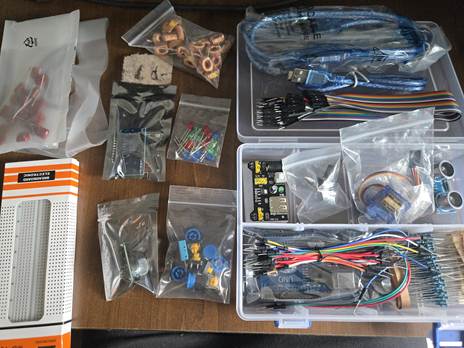
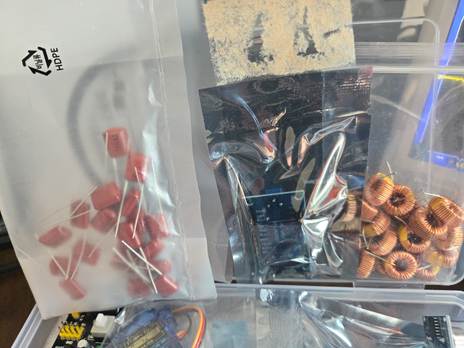
4. Bill of Materials and Approximate Cost
|
Item |
Specification |
Typical Price (USD) |
|
Microcontroller board |
Arduino Uno R3 or compatible board |
$8-$25 |
|
Breadboard power module |
MB102 or similar, 5V mode |
$2-$5 |
|
Breadboard |
Standard solderless breadboard |
$3-$8 |
|
Jumper wires |
Male-male jumper set |
$2-$6 |
|
Inductor |
100 uH |
$0.50-$2 |
|
Capacitor |
0.1 uF film capacitor |
$0.20-$1 |
|
Protection resistor |
100 ohm to 1 k ohm |
$0.05-$0.50 |
|
USB cable / power |
USB cable or 5V supply |
$2-$8 |
|
Oscilloscope |
Two-channel oscilloscope |
Existing lab / varies |
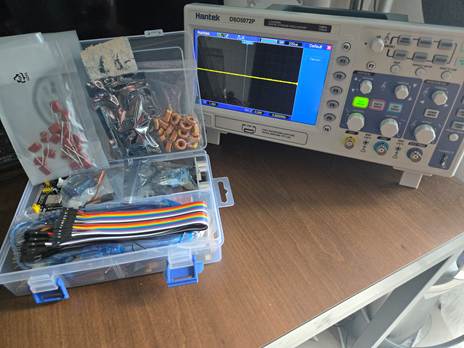
Estimated entry cost can remain under approximately $20-$50 for participants who already have access to a two-channel oscilloscope. Actual prices depend on country, shipping, official vs compatible parts, and local availability.
5. Observation and Data
Recommended setup: CH1 measures the LC node or voltage across the LC section; CH2 measures the input signal; trigger on CH2. Start around 200 us/div and adjust as needed. Record screenshots and, when possible, CSV waveform data.
Suggested data fields: alias, country, date, board type, exact L and C values, resistor value, signal source type, target frequency, duty cycle or waveform type, oscilloscope model, probe locations, time base, screenshot, optional CSV trace, observation result, and notes on possible artifacts.
6. Scope and Boundary
This release is intentionally modest. It is not a completed physical validation of CJM. A full physical validation may require high-Q resonators, low-noise waveform sources, precision frequency stabilization, sapphire-grade structures, and cryogenic temperature control.
If the circuit shows nothing, that result matters. If the circuit shows ordinary resonance, that result matters. If the circuit shows a transient alignment pattern, that result matters. Positive, negative, and uncertain observations are all part of the same evidence field.
Circuit Map and Witness Protocol
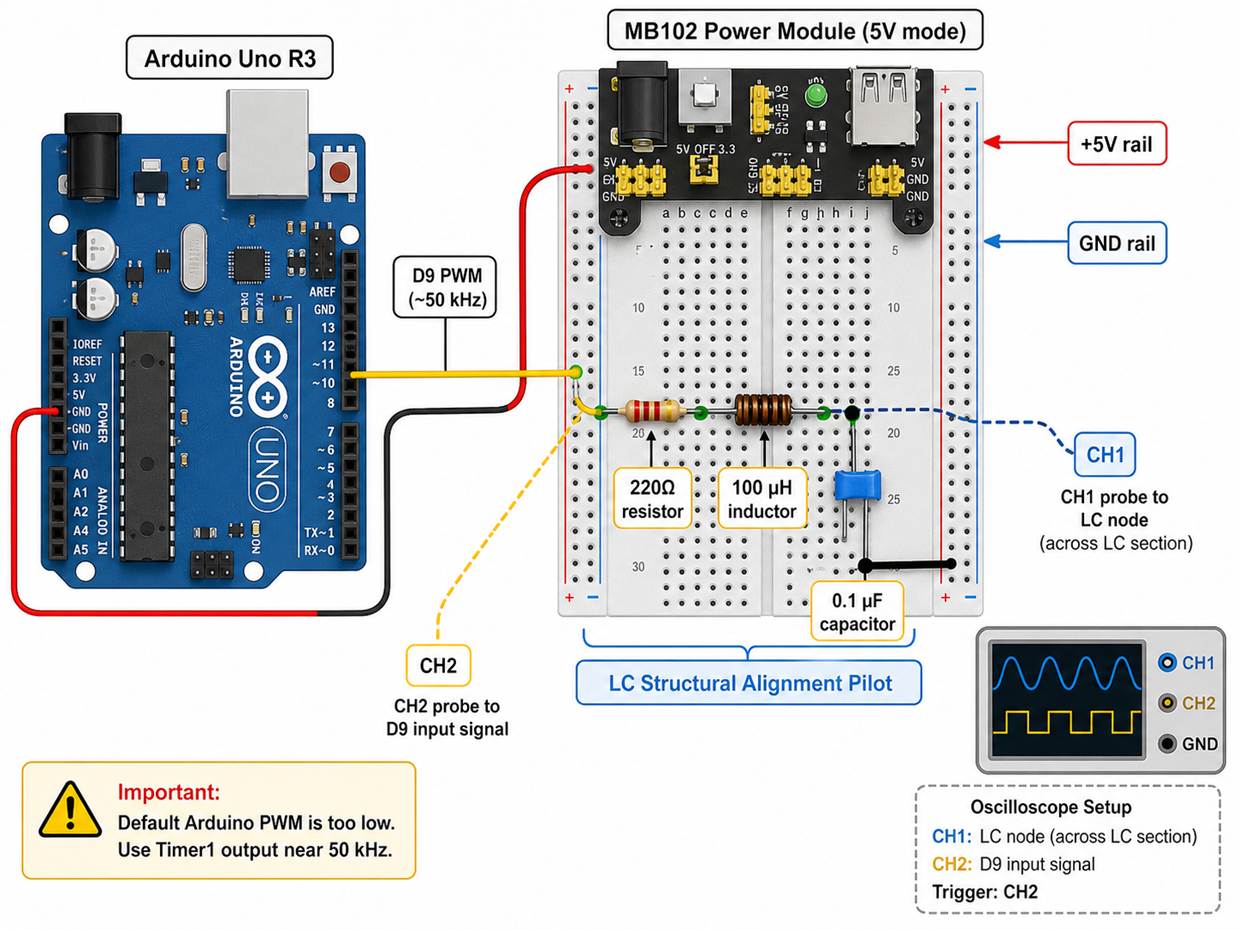
Figure 1. Low-cost LC structural alignment pilot wiring diagram.
7. The Witness
CJM Manifesto 1/3 is designed not to demand agreement, but to invite participation. A critic does not need to accept CJM to participate. To criticize the protocol meaningfully, one may build the circuit, record the waveform, and produce comparable data.
In this sense, criticism becomes replication, and disagreement becomes measurable evidence.
The project welcomes positive observations, negative observations, uncertain observations, artifact analysis, improved circuit implementations, oscilloscope screenshots, CSV waveform data, and independent replication notes.
8. Citation and Versioning
Recommended citation:
Yoon, K. (2026). CJM
Manifesto 1_3 The First Public
Alignment Release. Zenodo. DOI: [10.5281/zenodo.20038887].
Observe first. Record carefully. Interpret
later.
Atemporal Position. CJM is not introduced here as a
faster digital calculator or as an ordinary analog optimizer. Its atemporal
claim is narrower and deeper: an encoded structure may already contain its
admissible True/False condition before sequential search is performed. The LC
pilot asks whether such a pre-existing structural condition can leave a
reproducible physical alignment response in a resonant circuit.
Open
Question.
Does a problem admit
a solution if and only if it is structurally admissible under atemporal
resonance?
References
1. Turing, A. M. (1936–1937). On computable numbers,
with an application to the Entscheidungsproblem.
Proceedings of the London Mathematical Society, Series 2, 42(1), 230–265.
https://doi.org/10.1112/plms/s2-42.1.230
2. Riemann, B. (1859). Ueber
die Anzahl der Primzahlen unter einer gegebenen
Grösse. Monatsberichte der
Berliner Akademie, November 1859, 671–680.
3. Montgomery, H. L. (1973). The pair correlation of
zeros of the zeta function. In Analytic Number Theory, Proceedings of Symposia
in Pure Mathematics, Vol. 24, 181–193. American Mathematical Society.
4. Odlyzko, A. M. (1992).
The 10^20-th zero of the Riemann zeta function and 70 million of its neighbors.
Unpublished manuscript / computational report.
5. Conrey, J. B. (2003). The Riemann Hypothesis.
Notices of the American Mathematical Society, 50(3), 341–353.
6. Schumayer, D., &
Hutchinson, D. A. W. (2011). Colloquium: Physics of the Riemann hypothesis.
Reviews of Modern Physics, 83, 307–330.
https://doi.org/10.1103/RevModPhys.83.307
7. Cook, S. A. (1971). The complexity of
theorem-proving procedures. Proceedings of the Third Annual ACM Symposium on
Theory of Computing, 151–158. https://doi.org/10.1145/800157.805047
8. Gödel, K. (1931). Über
formal unentscheidbare Sätze
der Principia Mathematica und verwandter Systeme I. Monatshefte für Mathematik und Physik, 38, 173–198. https://doi.org/10.1007/BF01700692
9. Prigogine, I. (1978). Time, structure, and
fluctuations. Science, 201(4358), 777–785.
https://doi.org/10.1126/science.201.4358.777
10. Anderson, P. W. (1972). More is different.
Science, 177(4047), 393–396. https://doi.org/10.1126/science.177.4047.393
11. Maxwell, J. C. (1865). A dynamical theory of the
electromagnetic field. Philosophical Transactions of the Royal Society of
London, 155, 459–512. https://doi.org/10.1098/rstl.1865.0008
12. Tesla, N. (1891). Experiments with alternating
currents of very high frequency and their application to methods of artificial
illumination. Lecture before the American Institute of Electrical Engineers,
New York.
13. Coakley, K. J., Splett, J. D., Janezic, M. D.,
& Kaiser, R. F. (2003). Estimation of Q-factors and resonant frequencies.
IEEE Transactions on Microwave Theory and Techniques, 51(3), 862–868.
https://doi.org/10.1109/TMTT.2003.808578
14. Horowitz, P., & Hill, W. (2015). The Art of
Electronics (3rd ed.). Cambridge University Press.
15. Yoon, K. (2025). P ≡ NPᴶ: On the end of time. Zenodo. DOI: https://doi.org/10.5281/zenodo.18139629
16. Yoon, K. (2026). On Structural Criticality:
Atemporal Topological Discrimination of the Riemann Hypothesis.
Zenodo. DOI:
https://doi.org/10.5281/zenodo.18195907
17. Yoon, K. (2026). On Structural Form: Atemporal
Coherence of Hodge Classes in Algebraic Varieties
Zenodo. DOI: https://doi.org/10.5281/zenodo.19353046
This code does not submit the full 3SAT formula as a
single physical object. Instead, it uses a toy 3SAT formula to generate a
small, repeatable set of assignment-labeled frequency trials. The purpose is
not to demonstrate computational advantage, but to test whether the LC-CJM
setup can produce reproducible alignment-like responses under controlled
symbolic trial conditions.
/*
CJM Manifesto
1/3
LC Structural
Alignment Pilot v0.05-beta
Arduino Uno R3
Serial-Controlled Timer1 Output
Output:
D9 / OC1A
Serial command
format:
F50000
F50300
F49700
Meaning:
Set output
frequency in Hz.
Important:
This is for
Arduino Uno / ATmega328P at 16 MHz.
*/
const int outputPin = 9;
void setupTimer1(float frequencyHz) {
if (frequencyHz < 1000) frequencyHz
= 1000;
if (frequencyHz > 200000) frequencyHz
= 200000;
// Fast PWM
mode 14, TOP = ICR1
// Frequency =
16 MHz / (prescaler * (1 + ICR1))
// Prescaler = 1
unsigned long
top = (unsigned long)(16000000.0 / frequencyHz)
- 1;
if (top <
1) top = 1;
if (top >
65535) top = 65535;
noInterrupts();
TCCR1A = 0;
TCCR1B = 0;
TCNT1 = 0;
ICR1 = top;
OCR1A = top /
2; // 50% duty cycle
//
Non-inverting output on OC1A / D9
TCCR1A |= (1
<< COM1A1);
// Fast PWM
mode 14
TCCR1A |= (1
<< WGM11);
TCCR1B |= (1
<< WGM13) | (1 << WGM12);
// Prescaler = 1
TCCR1B |= (1
<< CS10);
interrupts();
}
void setup() {
pinMode(outputPin, OUTPUT);
Serial.begin(115200);
setupTimer1(50000.0);
Serial.println("CJM-LC READY");
Serial.println("Send command like F50000");
}
void loop() {
if (Serial.available()) {
String cmd = Serial.readStringUntil('\n');
cmd.trim();
if (cmd.length() > 1 && cmd.charAt(0) == 'F') {
float freq = cmd.substring(1).toFloat();
setupTimer1(freq);
Serial.print("OK ");
Serial.println(freq, 2);
} else {
Serial.println("ERR");
}
}
}
pip install pyserial
Beginner note: pip is Python’s
package installer. The command pip install
pyserial downloads and installs the serial
communication library needed by this experiment. Without pyserial,
the Python script can still be read, but it will not be able to connect to the
Arduino over USB.
"""
CJM Manifesto 1/3
LC Structural Alignment Pilot v0.05-beta
Simple 3SAT USB Trial Runner
Purpose:
1. Detect
Arduino-compatible serial port.
2. Send
trial frequencies near LC resonance.
3. Export
CSV submission template.
Important:
Upload the
provided Arduino sketch first.
This Python
script does not read oscilloscope data.
Participants
fill observation fields after checking CH1/CH2 manually.
"""
import csv
import math
import time
from itertools import
product
import serial
from serial.tools
import list_ports
#
------------------------------------------------------------
# LC setup
#
------------------------------------------------------------
L_HENRY = 100e-6
C_FARAD = 0.1e-6
F0_HZ = 1.0 / (2.0 * math.pi
* math.sqrt(L_HENRY *
C_FARAD))
#
------------------------------------------------------------
# Toy 3SAT formula
#
------------------------------------------------------------
CLAUSES = [
(+1, +2,
-3),
(-1, +2,
+3),
(+1, -2,
+3),
]
def eval_literal(literal, assignment):
var =
abs(literal)
value =
assignment[var]
return value
if literal > 0 else not value
def eval_clause(clause, assignment):
return any(eval_literal(lit, assignment) for lit in clause)
def eval_formula(clauses, assignment):
results = [eval_clause(clause,
assignment) for clause in clauses]
satisfied_count = sum(results)
sat_ratio = satisfied_count / len(clauses)
is_satisfying = all(results)
return is_satisfying, sat_ratio
def assignment_to_frequency(assignment):
"""
Convert
assignment into a small frequency offset around LC resonance.
This is only
a repeatable trial schedule.
It is not a proof mapping.
"""
bits = [assignment[1], assignment[2], assignment[3]]
code = sum((1 << i) for i, bit in enumerate(bits) if bit)
# 8
assignments -> offsets from -350 Hz to +350 Hz
offset_hz = (code - 3.5) * 100.0
return F0_HZ
+ offset_hz
#
------------------------------------------------------------
# Serial detection
#
------------------------------------------------------------
def find_arduino_port():
ports =
list(list_ports.comports())
if not
ports:
raise RuntimeError("No
serial ports found. Is the Arduino connected by USB?")
keywords = [
"arduino",
"uno",
"ch340",
"wch",
"usb serial",
"usb-serial",
"cp210",
]
for port in
ports:
desc = f"{port.description} {port.manufacturer or ''}".lower()
if any(k in desc for k in keywords):
return port.device
# Fallback:
if only one serial device exists, use it.
if len(ports) == 1:
return ports[0].device
print("Multiple serial ports found:")
for i, port in enumerate(ports,
start=1):
print(f"{i}. {port.device} | {port.description}")
choice = int(input("Select port number: "))
return ports[choice - 1].device
def connect_arduino(port, baudrate=115200):
ser = serial.Serial(port, baudrate=baudrate, timeout=2)
# Arduino
resets when serial opens.
time.sleep(2.5)
# Read any
startup text.
while ser.in_waiting:
line = ser.readline().decode(errors="ignore").strip()
if line:
print("Arduino:", line)
return ser
def send_frequency(ser, frequency_hz):
cmd = f"F{frequency_hz:.2f}\n"
ser.write(cmd.encode("utf-8"))
ser.flush()
reply = ser.readline().decode(errors="ignore").strip()
return reply
#
------------------------------------------------------------
# Main
#
------------------------------------------------------------
def main():
output_file = "cjm_3sat_lc_trials_usb.csv"
print("CJM Manifesto 1/3 | LC Structural Alignment
Pilot v0.05-beta")
print(f"Nominal LC resonance: {F0_HZ:.2f} Hz")
print()
port = find_arduino_port()
print(f"Detected serial port: {port}")
ser = connect_arduino(port)
rows = []
try:
for trial_id, values in enumerate(product([False,
True], repeat=3), start=1):
assignment = {
1: values[0],
2: values[1],
3: values[2],
}
is_satisfying, sat_ratio = eval_formula(CLAUSES,
assignment)
target_frequency = assignment_to_frequency(assignment)
assignment_bits = "".join("1"
if assignment[i] else "0" for i in [1, 2, 3])
print()
print(f"Trial {trial_id}")
print(f"Assignment x1x2x3: {assignment_bits}")
print(f"Target frequency: {target_frequency:.2f} Hz")
reply = send_frequency(ser, target_frequency)
print(f"Arduino reply: {reply}")
input("Observe oscilloscope CH1/CH2, save screenshot if
needed, then press Enter...")
rows.append({
"trial_id":
trial_id,
"assignment_bits_x1x2x3": assignment_bits,
"x1": int(assignment[1]),
"x2": int(assignment[2]),
"x3": int(assignment[3]),
"assignment_satisfies_toy_3sat": int(is_satisfying),
"assignment_clause_satisfaction_ratio":
round(sat_ratio, 4),
"lc_L_uH":
100,
"lc_C_uF":
0.1,
"nominal_f0_hz": round(F0_HZ,
2),
"target_frequency_hz":
round(target_frequency, 2),
"serial_port":
port,
"arduino_reply":
reply,
# Participant-filled fields
"observed_response": "", # alignment_observed / not_observed / inconclusive / possible_artifact
"alignment_strength_0_to_5":
"",
"ch1_setting": "",
"ch2_setting": "",
"timebase": "",
"scope_model":
"",
"screenshot_filename":
"",
"csv_waveform_filename":
"",
"notes": "",
})
finally:
ser.close()
with open(output_file, "w",
newline="", encoding="utf-8") as f:
writer =
csv.DictWriter(f,
fieldnames=rows[0].keys())
writer.writeheader()
writer.writerows(rows)
print()
print(f"CSV generated: {output_file}")
print("Fill observation fields and submit the completed
CSV with screenshots or waveform files.")
if __name__ == "__main__":
main()
This Python script is intended to be used together
with the accompanying Arduino serial-control sketch. Before running the Python
script, participants must first upload the Arduino sketch to an Arduino Uno R3
or compatible microcontroller board. The Arduino sketch enables the board to
receive frequency commands over the USB serial connection and generate a
corresponding output signal on the selected PWM/timer output pin.
After the Arduino is connected to the computer by USB,
the Python script attempts to detect the correct serial port automatically. If
multiple serial devices are connected, the script may ask the participant to
select the appropriate port manually. Once the connection is established, the
script generates a small set of trial conditions derived from a toy 3SAT
instance. These trial conditions are not intended to prove or solve 3SAT
physically. They are used only as a simple, repeatable structural input schedule
for testing the LC alignment pilot.
For each trial, the Python script sends a target
frequency near the nominal LC resonance frequency of the 100 µH and 0.1 µF
circuit pair. The Arduino then updates its timer output so that the participant
can observe the LC response on the oscilloscope. The recommended setup is to
connect CH1 to the LC node or across the LC section, connect CH2 to the input
signal, and trigger the oscilloscope on CH2. After each frequency is sent, the
script pauses and waits for the participant to inspect the oscilloscope display,
save a screenshot if desired, and optionally export waveform data from the
oscilloscope.
The script does not automatically read oscilloscope
data. It only controls the Arduino trial sequence and creates a CSV file for
submission. Participants should manually record their observations in the
generated CSV file, including whether alignment-like behavior was observed, not
observed, or uncertain. When possible, participants should also attach
oscilloscope screenshots or raw waveform CSV files and reference those
filenames in the submission CSV.
The purpose of this script is to make the pilot
experiment repeatable and easy to document. It provides a common trial
structure, common target frequencies, and a common data format so that results
from different participants and different experimental environments can later
be compared. Positive, negative, and uncertain observations are all valuable,
provided that the circuit conditions, measurement settings, and data files are
clearly recorded.
REPLICATION
REPORT FORM
CJM
Manifesto 1/3 • LC Structural Alignment Pilot v0.05-beta
Use
this form to submit a positive, negative, uncertain, or artifact-related
replication result.
|
Instruction. Complete this form after
reproducing the LC alignment pilot. Attach oscilloscope screenshots, waveform
CSV files, and a circuit photo whenever possible. Positive, negative,
uncertain, and artifact-related observations are all welcome. Please submit
the completed form and any supporting files to austiny@snu.ac.kr or
austiny@gatech.edu. |
||||||||||||||||||||||||||||||||||||||||||||||||||||||||||
|
1. Participant Information
2. Hardware Setup
3. Measurement Setup
|
4. Observation Result
5. Attached Evidence
6. Notes
7. Participant Statement
|
|
||||||||||||||||||||||||||||||||||||||||||||||||||||||||
|
|
||||||||||||||||||||||||||||||||||||||||||||||||||||||||||